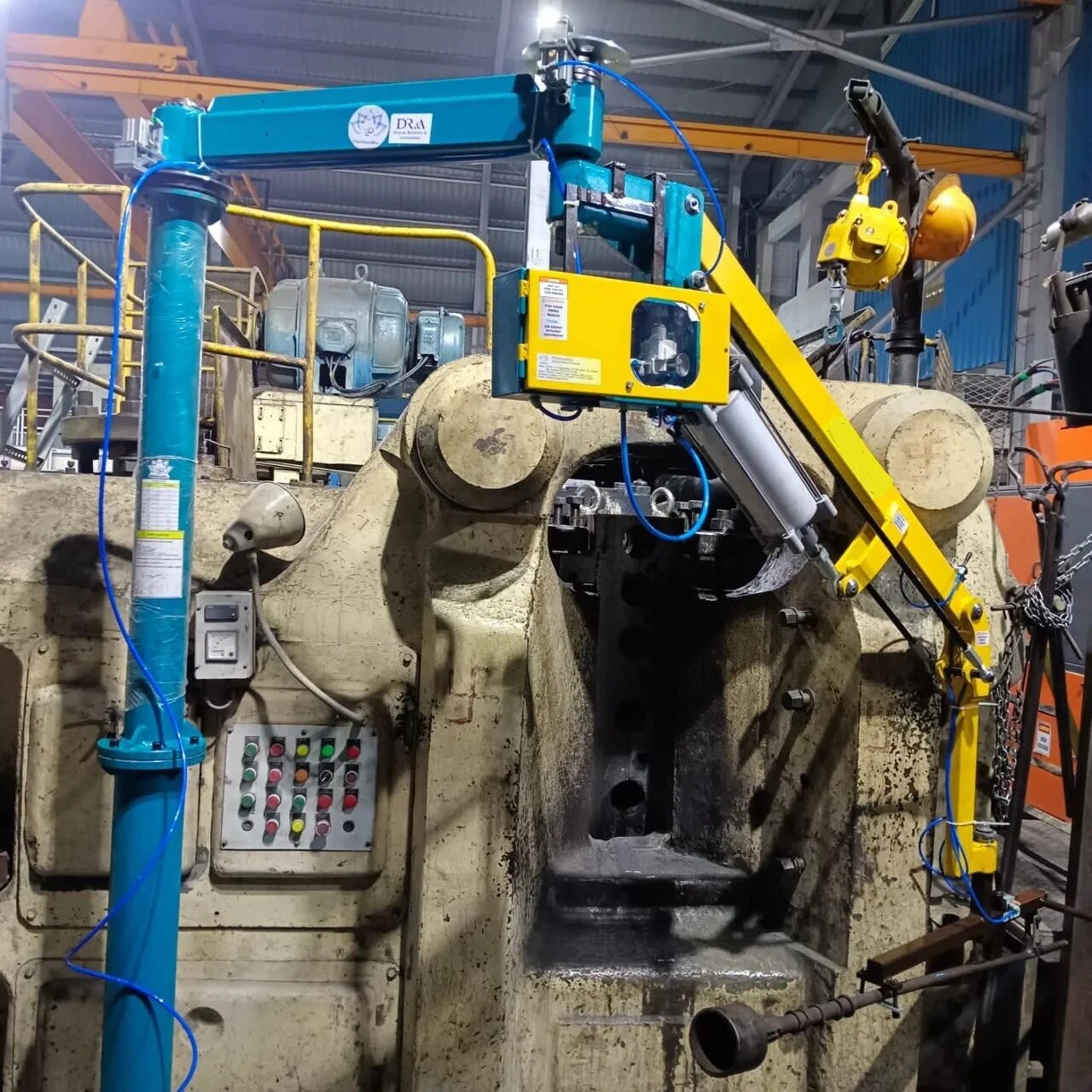
A DRA manipulator is not safe to return to production because it lifts an unloaded arm or passes a visual glance. You need a repeatable inspection, isolation, testing and documentation process that accounts for load position, tooling, air or hydraulic condition, duty cycle and the local factory environment.
Key takeaways
- Use the manufacturer’s manual and nameplate to set every maintenance interval.
- Inspect the manipulator, attachment, controls, hoses, cables and energy isolation points each shift.
- Validate capacity before returning a DRA-50 or DRA-80 to service.
- Escalate damaged or overloaded equipment to industrial manipulator recovery procedures.
What maintenance must cover during each shift, week, month and year
Treat DRA manipulator maintenance in Gurugram as continuous inspection, cleaning, adjustment, lubrication and controlled replacement—not a single annual service. Use the manufacturer’s manual, nameplate, duty cycle, number of shifts and movement frequency to set intervals. A generic “lubricate monthly” rule is unsafe when it conflicts with the DRA model instructions.
1. Every shift, inspect the frame, base, boom, joints, gripper or attachment, lifting mechanism, hoses, fittings, controls and emergency stop. Look for cracks, leaks, contamination, abnormal noise, backlash, uncontrolled drift, unusual resistance and damaged guards. Clean exposed slides, sensors and attachment surfaces without removing guards or defeating interlocks.
Stop the machine for sudden descent, repeated creep or loss of holding force.
2. Each week, check fastener movement and torque marks, damaged welds, bent members, corrosion, hose abrasion, air leaks, filter and drain condition, lubricator oil where specified, and foundation or anchorage movement. Inspect elongated anchor holes and distorted mounting plates; torque marks show movement but do not replace torque measurement.
3. Each month, service only the approved lubrication points and inspect seals, cables or chains, valve response, control-valve operation and adjustment values. Increase checks when Gurugram dust, monsoon humidity or condensation contaminates filters, slides, seals or electrical enclosures.
4. Each year, schedule a qualified overhaul covering structural members, pivots, bearings, brakes, cylinders, counterbalance components, electrical safety functions and lifting accessories. Take replacement parts, wear limits and lubrication types from the supplied procedure. Record the model, serial number, parts changed, test results and person authorizing release.
How to inspect the manipulator, attachment and energy systems
A sound inspection finds movement, cracking, leakage and control faults before a DRA manipulator loses a load or injures someone. Isolate the machine and release stored energy before examining load-supporting parts.
1. Examine the baseplate, anchors and mounting holes for cracks, elongated holes, distorted plates, loose fasteners and movement. Inspect every weld for cracking or separation; never paint over a suspect weld. Torque marks show later fastener movement, but they do not replace torque measurement.
2. Check the boom and joints for bends, corrosion, bearing play and backlash. Unusual noise, resistance, drift or a changed arm position requires investigation rather than adjustment by guesswork.
3. Inspect the gripper, hook, sling, chain or wire rope separately from the manipulator. Reject or escalate kinks, crushed sections, broken wires, deformed or cracked hooks, damaged latches and illegible capacity markings under the applicable accessory standard and the manufacturer’s limits.
4. Look for oil at cylinders, valves and fittings, listen for air leaks, and inspect hoses for abrasion, cuts, bulges, flattened sections and poor routing. Check the filter, regulator, lubricator where specified, drain and air line against the machine’s required air quality; do not substitute an assumed ISO 8573-1 class.
5. Operate control valves for sticking or delayed response. Test the emergency stop, end-of-travel limits, overload protection and interlocks without bypasses.
6. Photograph each defect and record its location and severity. Tag out the machine when a load-support, holding or safeguarding function is affected, then obtain qualified assessment before return to service.
How to validate capacity before returning a DRA-50 or DRA-80 to service
A 50- or 80-kilogram payload number alone cannot approve a DRA-50 or DRA-80 for service. Capacity changes with tooling, reach, centre of gravity, orientation, working envelope and movement speed.
1. Record the model, serial number, attachment identity, attachment mass, load centre of gravity, arm reach, orientation, working envelope and dynamic movement. Include the gripper, tooling and every extension in the load, not only the component being moved.
2. Compare that complete combination with the nameplate and manufacturer load chart. For DRA 50 kgs manipulator maintenance, verify the 50-kilogram maximum using the approved test arrangement. For DRA 80 kgs manipulator maintenance, verify the 80-kilogram maximum at the specified reach and position while examining the heavier-duty lifting and structural components.
3. Inspect for bent members, cracked welds, damaged pivots, brake slip, cylinder distortion and balance changes. An 80-kilogram rating does not provide 30 kilograms of extra capacity at every reach: at equal reach, its static load moment is 1.6 times that of 50 kilograms.
A gripper change can overload bearings, brakes or pivots below the nameplate limit.
4. Before release, support the arm with a rated maintenance stand, never its brake, cylinder or balancing mechanism. Complete a documented pre-use test: inspect the attachment, travel through the full unloaded envelope, test every control and the emergency stop, then lift a known approved load and check drift, descent, balance and resistance.
Record the test load and release authority.
When routine maintenance becomes industrial manipulator recovery
Repeated creep, sudden descent or loss of holding force is safety-critical, not a routine adjustment. Isolate the manipulator and call a qualified technician who can follow the original manufacturer’s procedure; leakage, a failed counterbalance valve, worn brake or damaged load-support part may be involved.
Operators handle visual checks, cleaning, basic function tests and fault reporting. They must not open pressure systems, alter balance settings or replace load-support parts. Planned preventive maintenance follows the DRA model procedure at approved intervals. Condition-based maintenance shortens that interval when cycle counts, trend data, repeated leaks, rising noise, backlash, contamination or drift show deterioration.
Repair addresses a confirmed defect; industrial manipulator recovery is the controlled return-to-service process that follows it.
- Make the area safe, record the arm position and load, and restrict access to the work envelope.
- Isolate electrical supply, pneumatic or hydraulic pressure, the suspended load, counterbalance energy and stored mechanical energy. Verify zero pressure at a gauge or test point; closing an upstream valve is not enough.
- Support the arm with a rated maintenance stand suitable for its maximum possible position and load. Never rely on the brake, cylinder or balancing mechanism.
- Inspect for secondary damage, repair the root cause, and record replaced hoses, valves, cylinders, brakes, springs, cables or counterbalance parts.
- Perform a no-load movement test, then test emergency-stop and protective functions.
- Conduct a controlled rated or approved proof-load test, record the result and obtain documented release authority before production resumes.
How Gurugram factories should schedule service and document release
Set service intervals from operating hours, cycles, shifts, movement frequency, load pattern and fault history—not from a calendar copied from a clean installation. For DRA manipulator maintenance in Gurugram, inspect filters, drains, exposed slides, seals, electrical enclosures, corrosion-prone fasteners and condensation more frequently when dust or monsoon humidity is visible.
| Interval trigger | What to inspect or service | When to shorten the interval |
|---|---|---|
| Operating hours or cycles | Lubrication, seals, joints, brakes and load-support parts | High cycle counts or repeated movement |
| Shift pattern and load | Tooling, attachment, anchorage, drift and structural members | Multiple shifts or frequent near-rated loads |
| Contamination or condensation | Filters, drains, slides, electrical enclosures and fasteners | Visible dust, moisture or corrosion |
| Fault history | Leaks, backlash, abnormal noise and holding performance | Repeated faults or worsening trends |
Record every intervention against the exact model and serial number. Include rated capacity, tooling identity, operating hours or cycles, fault symptoms, isolation confirmation, parts changed, lubricant or adjustment values, test position, test load, emergency-stop result, protective-function result and the person authorizing release.
Use a torque measurement tool for approved fastener tightening; a torque mark only shows that movement happened later. Escalate structural cracks, uncontrolled drift, damaged load paths, failed brakes, persistent leaks and safety-device faults to a qualified technician or the original manufacturer.
When its procedure, parts or diagnosis are needed, Hendo Industries can be one service contact. Compare providers by exact model identification, safeguard preservation, documented test loads and a signed return-to-service record—not a promise of quick repair.
Related products
 | Manipulator The DRA-50 KGS Manipulator by Hendo Industries is a versatile and high-performance material handling solution designed to simplify lifting and... View product → |
 | Manipulator The DRA-80 KGS Manipulator by Hendo Industries is a robust and efficient material handling solution designed to streamline industrial operations. View product → |
Frequently asked questions
What must DRA manipulator maintenance cover during each shift, week, month and year?
Set intervals from the manufacturer’s manual, nameplate, duty cycle, shifts and movement frequency. Cover cleaning, inspection, adjustment, lubrication and controlled replacement rather than relying on a generic monthly rule.
How do you inspect a DRA manipulator, attachment and energy systems?
Inspect the structure, joints, fasteners, attachment, hoses, cables, controls and energy isolation points for damage, looseness, leaks, abnormal wear and unsafe movement before release.
How do you validate capacity before returning a DRA-50 or DRA-80 to service?
Check the model and nameplate rating, confirm the attachment and load stay within the specified capacity, and verify controlled movement after maintenance before authorising use.
When does routine maintenance become industrial manipulator recovery?
Treat the work as recovery after overload, collision, structural damage, uncontrolled movement, major energy-system failure or any condition that requires isolation, fault diagnosis and a documented engineering release.
How should Gurugram factories schedule service and document release?
Assign intervals by duty and shift pattern, isolate the equipment before work, record findings and replaced parts, document tests, and name the person authorising return to service.