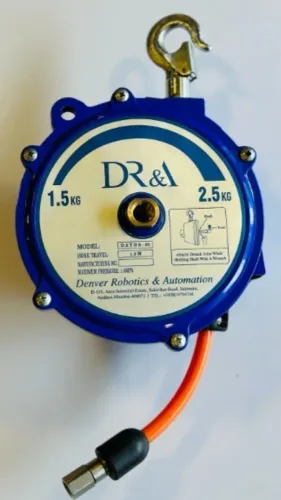

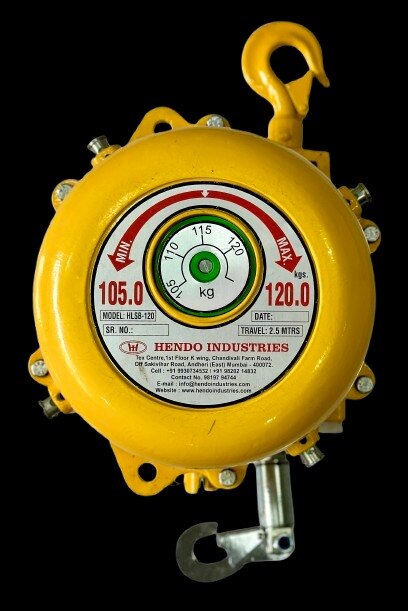
The model number alone cannot tell you whether a balancer will support your tool, reach the work area, or hold the tool neutrally. By checking the complete suspended load, travel, mounting arrangement, adjustment range, and supplier documentation, you can choose between HSB 1 and HSB 2 with a defensible specification rather than a guess.
Key takeaways
- Treat HSB 1 and HSB 2 as manufacturer-specific model names.
- Select the balancer for the complete suspended load, not the tool alone.
- Check mounting height, cable travel and working envelope at the workstation.
- Request the exact model code and specification sheet before ordering.
What the HSB 1 and HSB 2 model names actually tell you
HSB 1 and HSB 2 are manufacturer-specific model designations, not universal industry classifications. The number alone does not identify a standard load range, cable stroke, spring type, or housing size, so an HSB 1 flat series spring balancer from one manufacturer is not automatically equivalent to an HSB 1 from another.
| Model | What the name tells you | What it does not tell you |
|---|---|---|
| HSB 1 | The manufacturer’s designation for one model or capacity class | Rated load limits, travel, spring construction, dimensions, or mounting |
| HSB 2 | The manufacturer’s designation for another model or capacity class | Whether it is stronger, longer-travel, heavier, or suitable for your tool |
For a useful flat series spring balancer comparison, request the exact model code and current manufacturer data sheet. Record these specifications for each unit:
- Rated minimum and maximum load
- Cable travel and adjustment range
- Cable diameter, material, and construction
- Housing dimensions and net weight
- Hook dimensions and mounting details
Do not infer the practical difference from the model number. Two models can have overlapping load ranges, yet one may offer different travel, adjustment, cable construction, or mounting geometry. Compare the documented specifications, not the label.
Choose by complete suspended load and working envelope
Weigh the complete suspended assembly, not the bare tool, before choosing HSB 1 or HSB 2. Include:
- Tool, chuck or bit, hose, cable strain relief, hook, fixture, reaction arm, and every attached accessory.
A bare-tool measurement can leave the assembly outside the balancer’s adjustment range. Do not target the published maximum: operation near that limit leaves little balancing margin, while an oversized unit can pull an unloaded tool upward.
For any hsb 1 vs hsb 2 flat series spring balancer in gurugram, request the documented minimum and maximum supported load for the exact model code.
| Check | HSB 1 | HSB 2 |
|---|---|---|
| Complete suspended mass | Select only if the assembled load falls inside its documented range | Select only if the assembled load falls inside its documented range |
| Adjustment margin | Reject a choice that operates at the upper limit | Prefer the model leaving useful margin, not merely the higher rating |
| Cable travel | Must reach the lowest working point | Must reach the lowest working point |
| Cable path | Keep the cable close to vertical, without dragging, side loading, or housing contact | Keep the cable close to vertical, without dragging, side loading, or housing contact |
That cable requirement is separate from load capacity and belongs in every flat series spring balancer comparison. A spring balancer supports a working load; it is not a powered hoist, personnel-lifting device, or sole restraint for a dropped-load hazard.
Mount, balance, and adjust the unit at the real workstation
Mount either unit to a verified structural beam, overhead rail, trolley, bracket, or fixed anchor rated for the suspended load plus applicable dynamic or accidental loading. Do not attach an HSB 1 flat series spring balancer or HSB 2 flat series spring balancer to a light sheet-metal panel, small machine bracket, or unverified trolley.
Add a separate safety chain or wire rope when a failed balancer could endanger an operator, machine, or workpiece. Connect this safeguard to suitable structure; the operating cable is not a substitute, because a spring, cable termination, hook, or mounting point can fail independently.
Keep the balancer approximately in line with the tool’s vertical path. Side-pulling, dragging the tool horizontally by the cable, or letting the cable touch the housing creates friction and erratic retraction while accelerating guide, cable, and drum wear.
Tune the load adjustment only after hanging the complete tool assembly—tool, chuck or bit, hose, strain relief, hook, fixture, and accessories—at the actual working height. Check several heights because the wound flat spring changes force as the drum position changes.
- Upward pull with the tool unloaded means the setting or unit is too strong.
- Downward drift means the suspended assembly exceeds the effective setting or load range.
- Jerky or erratic retraction points to friction, an angled mount, side loading, or cable contact; correct the installation before increasing spring tension.
Build a specification-by-specification HSB 1 versus HSB 2 comparison
A reliable flat series spring balancer comparison records the same specifications for both units, not just the HSB 1 and HSB 2 names.
| Specification | HSB 1 | HSB 2 |
|---|---|---|
| Minimum and maximum supported load | Confirm data-sheet values | Confirm data-sheet values |
| Cable travel | Record working stroke | Record working stroke |
| Cable diameter and material | Record both | Record both |
| Hook dimensions and type | Record opening, throat and swivel or fixed design | Record opening, throat and swivel or fixed design |
| Housing dimensions and net weight | Record length, width, height and mass | Record length, width, height and mass |
| Casing material | Identify steel, aluminium or other material | Identify steel, aluminium or other material |
| Flat spring and drum construction | Record spring arrangement and drum material | Record spring arrangement and drum material |
| Mounting arrangement | Identify eye, bracket, trolley or other mount | Identify eye, bracket, trolley or other mount |
| Load adjustment | State range and procedure | State range and procedure |
| Operating environment | Record temperature, dust, moisture or corrosion limits | Record temperature, dust, moisture or corrosion limits |
| Safety provisions | Identify lock, secondary attachment or other devices | Identify lock, secondary attachment or other devices |
| Replacement parts | Confirm spring and cable availability | Confirm spring and cable availability |
Check whether adjustment is external or requires opening the housing, and whether a cable can be replaced on site. Confirm that published travel reaches the lowest point of your work envelope without side loading or rubbing.
Housing dimensions affect clearance and operator access; mounting details affect trolley selection and fit. Load rating alone cannot distinguish an HSB 1 flat series spring balancer from an HSB 2 flat series spring balancer.
Specify the exact model when buying from a spring balancer supplier in Gurugram
Require a document trail before placing an order with a spring balancer supplier in Gurugram. The purchase order must identify the equipment by its exact model code, not only “HSB 1” or “HSB 2”; those labels are manufacturer-specific and are not interchangeable, even when two housings look alike.
1. State the exact model code and published minimum-to-maximum load range. Confirm that the rating covers the complete suspended assembly: tool, chuck or bit, hose, cable strain relief, hook, fixture, and accessories.
2. Record the cable travel, cable diameter, hook configuration, and mounting method. Match these details to the workstation’s lowest working point, overhead support, trolley or bracket, and required cable path.
3. Require inspection or test documentation identifying the supplied unit, plus written warranty terms. Ask for the local service and spare-parts contact, including who supplies replacement cable or spring components.
For an HSB 1 vs HSB 2 flat series spring balancer in Gurugram, compare the supplier’s data sheet and records rather than treating the model name as proof of suitability.
Hendo Industries can help match the complete suspended load and workstation arrangement to documented equipment, but you should still have every agreed specification and record written into the purchase order. A visually similar substitute with a different spring range or travel can leave the tool outside its adjustment range.
Related products
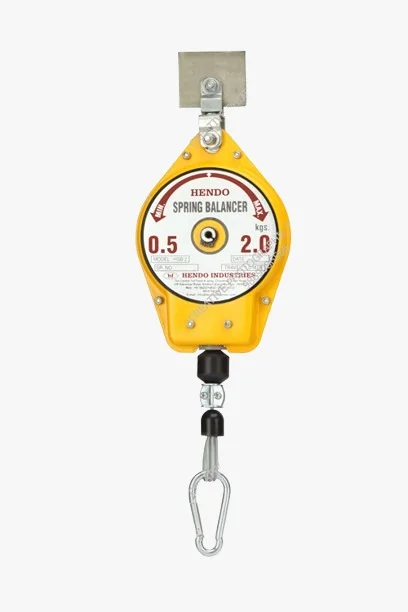 | FLAT SERIES SPRING BALANCER FLAT SERIES SPRING BALANCER HSB-1 The HSB-1 Flat Series Spring Balancer by Hendo Industries is a compact and efficient lifting solution designed to improve productivity and reduce... View product → |
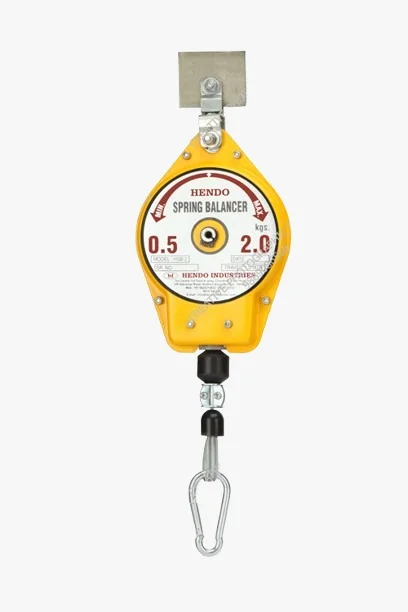 | FLAT SERIES SPRING BALANCER FLAT SERIES SPRING BALANCER HSB-2 The FLAT SERIES SPRING BALANCER HSB-2 by Hendo Industries is a high-performance industrial balancing solution designed to support lightweight tools... View product → |
Frequently asked questions
What do the HSB 1 and HSB 2 model names tell you?
They identify manufacturer-specific models. The numbers alone do not establish load range, cable stroke, spring type or housing size.
How should you choose between an HSB 1 and HSB 2 flat series spring balancer?
Compare each model’s complete suspended-load capacity, cable travel, mounting arrangement and working envelope against the actual workstation.
What should you check when mounting and adjusting a flat series spring balancer?
Mount it at the real suspension point, include the tool and accessories in the load, then adjust balance through the actual operating range.
What should you request from a spring balancer supplier in Gurugram?
Request the exact HSB model code, load range, cable travel, mounting details, adjustment method and current specification sheet.