A suspended tool can still fall when its cable, hook, anchor or attachment point is wrong, and a poorly selected balancer can leave the operator carrying most of the load. You will be able to trace the load path, match the complete tool weight to a working range, install and test the unit, and decide when a separate tether or another handling system is necessary.
Key takeaways
- Include the tool, hose, cable, chuck and accessories in the suspended load.
- Use a rated anchor and inspect the cable, drum, spring and connector before work.
- Set the balancer so the tool hangs near the operator’s shoulder and working zone.
- Choose another system when the load varies widely or the tool needs powered movement.
How the spring, cable and anchor control a tool drop
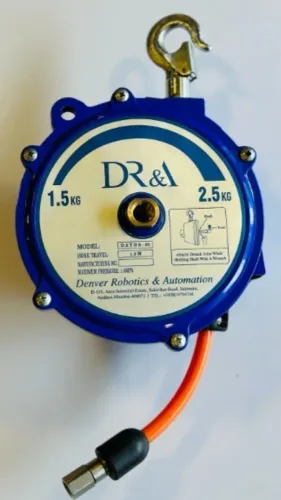
The protection chain runs from a rated overhead anchor, through the balancer housing and drum, along the cable, and into the tool connector. The drum spring applies an upward cable force that approximately counterbalances the complete suspended mass, but the tool is not weightless: you still supply positioning, trigger, reaction-torque and poorly balanced-tool forces.
As you pull the tool down, the cable unwinds under controlled spring tension. Release the handle and the spring retracts the cable, bringing the tool upward instead of leaving slack that can snag, loop or accelerate unpredictably.
An anti-drop or safety-lock feature is model-specific: one design may lock after a sudden speed increase or spring failure, while another locks only at selected cable positions.
Drops start at predictable weak points:
- An undersized capacity, overextension or a frayed or kinked cable
- A deformed hook, broken latch, failed clamp or failed eye bolt
- An incorrectly mounted housing or an overhead anchor without a verified load rating
- A tool detached from its connector
A balancer supports a tool; it is not automatically fall-arrest equipment or a positive tool tether. For a sheet metal spring balancer for tool drop problems in Gurugram, separate weight compensation from independent retention when choosing tool drop prevention equipment.
If your dropped-object assessment requires retention, fit a separately rated sling, lanyard or tether to a suitable tool attachment point.
How to match the balancer to the complete tool load
Match the complete suspended mass—not the casing number—to the manufacturer’s working-load range. Add the tool, socket, adaptor, hose, electrical lead, cable, reaction arm and every accessory hanging from the unit, then compare the total with the stated minimum and maximum load and usable stroke.
A load near the upper limit leaves little operating margin, causing poor balance, spring stress or rapid upward retraction when released.
Ask for the balance-force curve or permitted imbalance across the full cable travel. The effective drum radius changes as cable layers build, so a tool that feels balanced at one extension can pull heavily at another. Use the tool’s reach, duty cycle, working posture and load changes—not just its parked weight—to make the final selection.
Before choosing either model, obtain the current datasheet for:
- Safe working load and usable stroke
- Cable diameter and hook or connector type
- Lock arrangement and adjustment procedure
- Mounting requirements and permitted suspension orientation
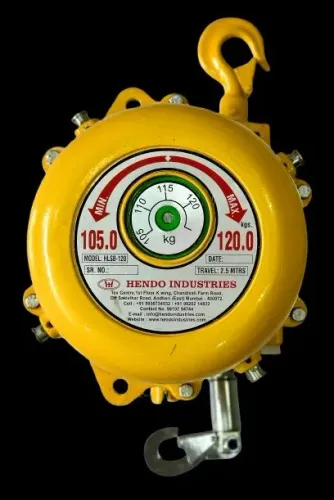
HLSB 22 spring balancer and HLSB 30 spring balancer are product designations, not proof of 22 kg or 30 kg capacity. A sheet metal spring balancer in Gurugram must be selected from verified data.
| Designation | What it tells you | What it does not prove |
|---|---|---|
| HLSB 22 | The manufacturer’s model identifier | A 22 kg safe working load |
| HLSB 30 | The manufacturer’s model identifier | A 30 kg safe working load |
How to install and commission a balancer without creating a new hazard
Install the balancer only after verifying the complete load path, from the tool to the beam or building structure. The unit is tool drop prevention equipment, not proof that an improvised anchor is safe.
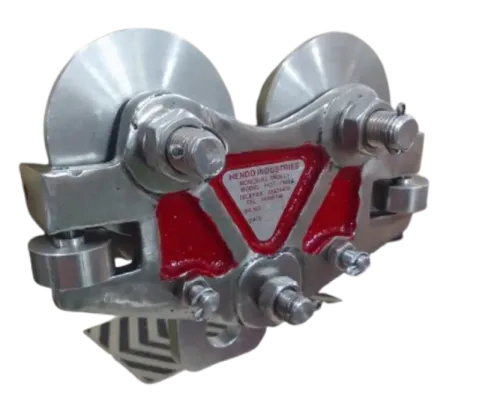
1. Survey the work cell. Identify the operator’s reach, tool travel, nearby people, fixtures and impact zones, then select a beam, trolley, rated eye bolt or bracket with a verified working-load rating.
2. Check every connection between the structure and tool. Confirm compatible fasteners, anchor capacity and mounting orientation; prevent side loading at the suspension point.
3. Mount the unit above and slightly in front of the working zone. Keep the cable close to vertical, because a sharp sideways pull increases wrist, shoulder and anchor loading.
4. Route the cable clear of sharp edges and pinch points. Fit the specified hook or connector to the tool’s rated attachment point, then add a separately rated sling, lanyard or tether when the risk assessment requires independent retention.
5. Commission the complete tool set, including sockets, hoses, leads, adaptors and reaction arms—not an empty hook. Check balance at minimum, middle and maximum working extension, test controlled return, verify the end stop, operate the hook latch and confirm that the tool cannot strike a person or workpiece.
6. Record the model, serial or batch identification, rated load, anchor rating, inspection owner, installation date, risk assessment and operator training in the site safety file. Apply the same evidence standard when buying a sheet metal spring balancer for tool drop problems in Gurugram.
How correct positioning reduces shoulder, wrist and repetition strain
Set the suspension height so the handle sits near your neutral elbow and wrist position during drilling, fastening, grinding, welding or assembly. This prevents shoulder elevation, overhead reaching and excessive wrist deviation.
Keep the tool inside your natural working zone, with the cable hanging close to vertical; a large horizontal angle creates sideways force on your wrist and the overhead anchor.
Let the spring carry the suspended tool’s weight, not the work itself. You still control feed pressure, trigger force, reaction torque, vibration and alignment. Correct positioning reduces cumulative strain more effectively than simply choosing a higher-capacity HLSB 30 spring balancer instead of an HLSB 22 spring balancer.
Use this operating check:
1. Pull the tool smoothly to the work and avoid dragging it sideways against the cable. Release the handle under control, then confirm that it returns without swinging into a person, fixture or finished part.
2. Reassess the workstation after installation. Measure reach distance, work height, repetition, grip force, wrist deviation and torque; a balancer cannot correct an excessively heavy, vibrating or poorly balanced tool.
3. Remove the unit from service after a shock load, dropped tool or abnormal return. Inspect cable strands, hook deformation, latch action, loose fasteners, housing damage, uneven winding and unusual spring noise. Never knot, weld or shorten a damaged cable in the field.
When a balancer is the right choice in Gurugram—and when it is not
Choose a sheet metal spring balancer in Gurugram when the tool stays inside a defined overhead work zone and needs weight compensation. Do not choose it as automatic fall-arrest or full fail-safe tool drop prevention equipment.
| Option | Working-load range and travel | Balance, locking and retention | Inspection, environment and spares |
|---|---|---|---|
| Sheet metal spring balancer | Defined tool load with limited cable travel | Continuous weight compensation; model-specific lock; add a separately rated tether | Check cable, spring, hook, anchor and lock at the specified interval; verify dust, sparks, vapour, outdoor and washdown limits; confirm spare cable and hook supply |
| Tool tether or safety lanyard | Follows the operator farther than a fixed balancer | Prevents a detached tool from reaching the floor but does not lift or balance it | Inspect attachment points, cuts and abrasion; select materials for the work environment |
| Retractable reel | Longer guided travel with cable retraction | Holds the line under tension; does not provide spring balance for a heavy tool | Confirm line material, lock behaviour and replacement availability |
| Hoist or counterweight system | Suits controlled lifting or changing elevations | Provides lifting control, not necessarily independent retention | Inspect rope, brake, hook and structure; verify service support |
| Fixed bench mount | Best for a stationary tool and repeatable position | No overhead travel or drop protection unless separately fitted | Inspect fasteners and tool attachment; environmental limits still apply |
Reject the balancer when the tool travels far from its anchor, needs controlled lifting, receives impact or free-fall loads, has sharp edges, exceeds the rated range, or requires independent retention. A sheet-metal housing does not prove resistance to abrasive fabrication dust, sparks, hot work, chemical vapour or washdown.
Ask a Gurugram supplier or installer for a site survey, anchor verification, current datasheet, inspection interval, spare-cable and hook availability, response time and operator training. Hendo Industries is relevant only if it documents the selected model’s working range, installation requirements, inspection support and independent-retention arrangement for your work cell.
Related products
 | SHEET METAL SPRING BALANCER HLSB-30 (2.5 MTRS) SHEET METAL SPRING BALANCER The HLSB-30 (2.5 MTRS) Sheet Metal Spring Balancer by Hendo Industries is a robust and efficient industrial tool balancing solution designed to... View product → |
 | SHEET METAL SPRING BALANCER HLSB-22 (2.5 MTRS) SHEET METAL SPRING BALANCER The HLSB-22 (2.5 MTRS) Sheet Metal Spring Balancer by Hendo Industries is a durable and high-performance industrial balancing solution designed for... View product → |
Frequently asked questions
How does a spring, cable and anchor prevent a tool drop?
A rated overhead anchor supports the balancer housing, while the drum spring applies upward cable force. The cable and tool connector must remain intact and correctly rated; the spring only counterbalances the load and does not replace a secondary drop-prevention measure where your risk assessment requires one.
How do you match a sheet metal spring balancer to a tool load?
Weigh the complete suspended assembly, including the tool, hose, cable, chuck, fittings and accessories. Select a balancer whose specified operating range contains that total load, then test the tool through its full travel before production use.
How should you install and commission a spring balancer safely?
Fix it to a rated overhead anchor, secure the tool connector, check cable alignment and install any required secondary retention. Inspect the housing, drum, spring and cable, then test retraction, travel, tool clearance and the locked position without people beneath the suspended load.
When is a spring balancer the wrong choice?
Use another handling system when the load changes beyond the balancer’s range, the tool needs powered vertical movement, the work requires large horizontal travel, or reaction torque remains too high after correct positioning.