A DRA model name and a 50 kg or 80 kg headline rating do not tell you what arrives at your plant, what payload remains after tooling, or whether the machine will work at your required reach. By the end, you will have a checklist for the supplied equipment, technical data, plant services, safety documents, installation scope, and acceptance tests that belong in the quotation.
Key takeaways
- Require every base-machine item as a quoted line item with quantity and model.
- Confirm capacity at the tool interface, including the gripper and payload.
- Separate supplied equipment from utilities, foundations, installation and site work.
- Make the supplier document controls, suspended-load behaviour and acceptance tests.
Separate the supplied machine from options and site work
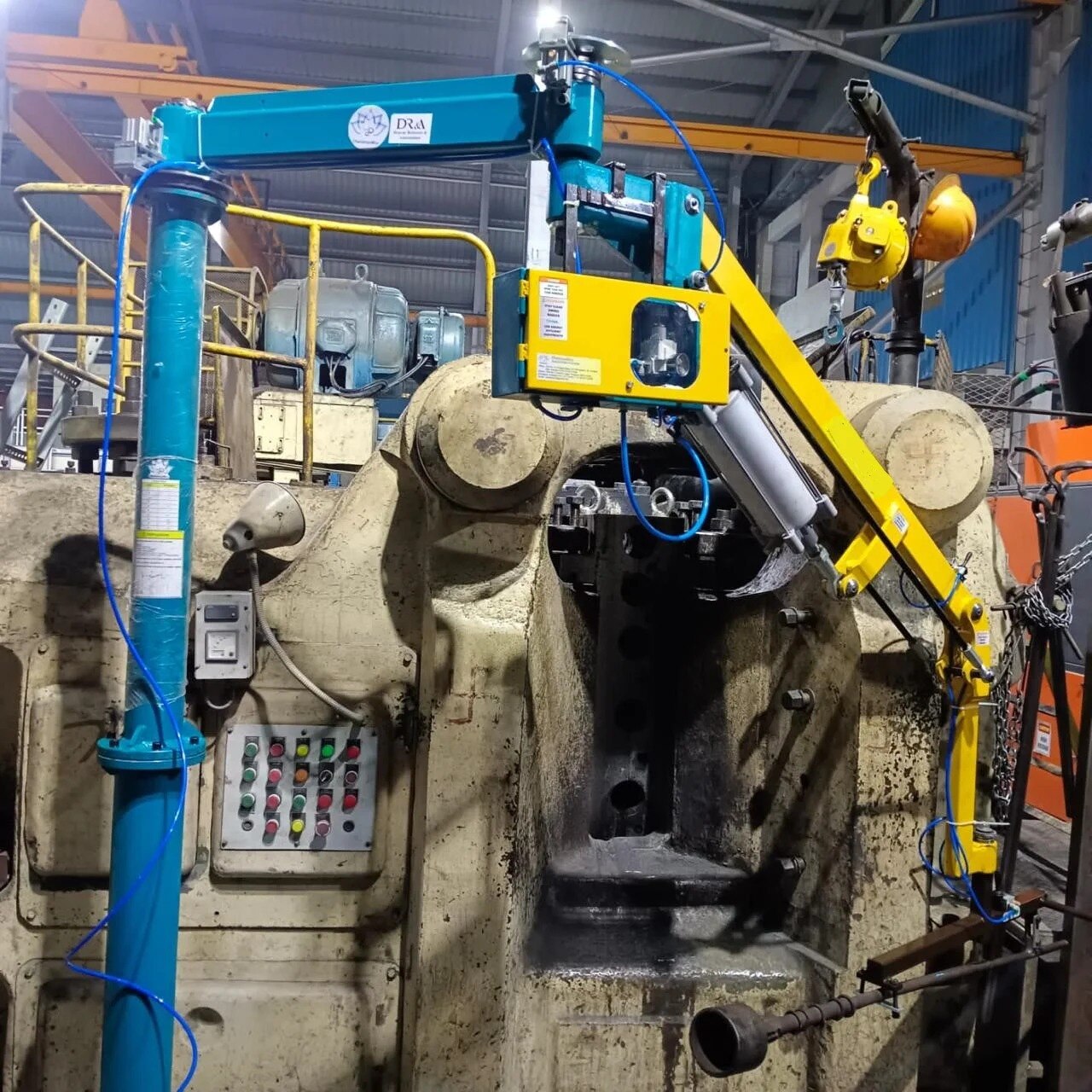
A quotation should show the complete base machine, not just “DRA-50” or “DRA-80.” Ask what comes with a DRA manipulator before buying, and require each supplied item to appear as a line item with quantity, model and scope.
- Manipulator assembly, balancer or actuator, and specified control system
- Floor pedestal, column or overhead support, with anchoring hardware
- Control pendant, emergency-stop circuit, hoses, cables and connection fittings
- Pneumatic filter-regulator-lubricator assembly, if included in the machine package
- Standard tool interface, guards, fasteners, manuals, drawings and spare-parts list
- End effector only if the quotation identifies its design, mass, capacity and included tooling
List the gripper, magnetic lifter, vacuum generator, cups, custom fingers, hooks, adapters and part-specific fixture separately. A “tooling provision” is not a gripper, and a rated manipulator capacity does not automatically include its mass.
Keep plant utilities and site work outside the machine price unless the supplier expressly includes them. Price the compressed-air connection separately from the factory compressor, and state minimum and maximum pressure, air consumption at the quoted cycle rate, connection size and required air quality. Identify whether a dryer or extra filtration is needed.
For a floor unit, request foundation and anchor details; for a column or overhead unit, request structural calculations covering dead weight, payload, dynamic effects and reaction moments. The quotation should also separate site survey, installation, electrical or air-drop work, commissioning, operator training and travel.
Ask for response times and local spare-parts coverage rather than assuming Pune supply means Pune support.
Read the capacity rating at the tool interface, not in the headline
A DRA-50 or DRA-80 is suitable only when its load chart confirms the part at the actual tool-interface position, reach, height and orientation. The headline rating alone does not prove that it can reach a vehicle body, die, pallet or fixture.
Ask whether the stated capacity includes the gripper, vacuum cups, hooks, adapters, hoses and cables. A 50 kg rating carrying a 12 kg gripper leaves only 38 kg before accounting for an offset centre of gravity or reduced capacity at full reach.
Request a dimensional drawing and capacity curve showing:
- Maximum and minimum reach, horizontal offset and vertical stroke
- Arm envelope, clearance height and mounting arrangement
- Tool-interface dimensions and emergency-stop position
- Permitted load centre of gravity at each reach
- Swivel range, wrist rotation and orientation limits
- Rated load, minimum load, duty cycle and operating speed
Then describe the real part, not just its mass. State whether it is oily, wet, hot, sharp-edged or painted; identify the gripping points, required orientation, fixture access, cycle time and allowable marking. A gripper that lifts the weight can still fail if it slips, marks the surface or cannot clear the die.
Use these DRA manipulator specifications to compare a DRA 50 kg manipulator in Pune with a DRA 80 kg manipulator. Ask for a demonstration using your part or an identical load, at the furthest reach and required orientation.
A DRA 80 kg manipulator is not automatically the safer choice if its interface, reach or centre-of-gravity limits do not match the task.
Specify utilities, controls and suspended-load behaviour
Approve the machine only after the quotation states exactly how it is powered, controlled and supported when air, electricity or a control signal disappears. “Pneumatic DRA” alone leaves the most dangerous questions unanswered.
1. Request the exact model and DRA manipulator specifications: working radius, vertical stroke, mounting arrangement, load centre, duty cycle, control type and required operating speed.
2. Record minimum and maximum air pressure, consumption at the specified cycle rate, connection size and air-quality requirement. Confirm whether the package includes a filter, regulator, lubricator or dryer; the plant compressor is normally site-provided.
3. Specify electrical voltage, phase, current, enclosure rating and cable termination. State what happens after power restoration: the machine must not restart or move without a deliberate operator command.
4. Define controls by function: hold-to-run or maintained, single-hand or two-hand, proportional or binary motion, adjustable speed, position stops, overload protection, soft-start and controlled descent.
5. Obtain a written response to air loss, hose rupture, control failure and emergency-stop activation. Identify the load-holding valves, brakes and counterbalance devices, then state whether the suspended load remains held, descends in control or releases.
6. Require a manual recovery method for a trapped or failed load. An emergency stop does not by itself support suspended tooling.
Before approval, document the exclusion zone, operator sightline, isolation points, lockout procedure and guarding for crushing or shearing points. Add foundation or structural loads for the selected floor, column or overhead mounting arrangement.
Check the installation, documents and acceptance test
A supplier must prove the installed machine works with your production tooling, not merely show that the arm lifts a test weight. Record the exact model, working radius, vertical stroke, mounting arrangement, load centre, duty cycle and control type; “DRA 80 kg manipulator” is not a sufficient specification.
1. Verify the installation against the approved drawing. For a floor-mounted unit, check anchor size, embedment and foundation requirements. For a column- or overhead-mounted unit, obtain structural calculations covering dead weight, payload, dynamic effects and overturning or reaction moments. Confirm that hoses, cables, guards and counterbalance components are installed.
2. Collect the handover file. It must include the risk assessment and risk-reduction record, operating instructions, maintenance schedule, spare-parts list, pneumatic and electrical schematics, inspection intervals, declaration of conformity, and records of operator training.
For a pneumatic unit, confirm pressure limits, air consumption at the production cycle rate, connection size, air-quality specification and included filter, regulator, lubricator or dryer.
3. Run a site-acceptance test after anchoring and utility connection. Use the real part, centre of gravity and production gripper, including the gripper’s mass in the tool-interface payload. Test pickup, travel, rotation, placement, release, emergency stop, loss of air or power, restart and representative cycle time.
4. Require signed acceptance criteria before release to production. A failed stop, unstable load, incomplete document, excessive cycle time or movement outside the approved envelope remains an open defect; a later successful lift does not erase it.
Turn a Pune supplier comparison into a written buying decision
Choose the automotive manipulator supplier in Pune whose quotation makes support measurable, not the one with the most attractive DRA model name. For a DRA 50 kg manipulator in Pune, compare the complete operating package against your part weight, cycle rate and mounting location.
| Supplier evidence | What to require in writing | Buying implication |
|---|---|---|
| Local support | Site survey, technician coverage, breakdown response time and Pune-area references for comparable loads and cycles | Reject “local supply” without a defined service commitment |
| Tooling scope | Gripper, fingers, vacuum generator, magnetic lifter, hoses, adapters and spare seals listed by part number and price | Subtract tooling weight from usable payload; price custom tooling separately |
| Installation scope | Foundation or structural calculations, anchor loads, erection, commissioning and operator training | A low machine price is incomplete if site work is chargeable later |
| Lifecycle support | Spare gripper parts, seals, pendant components, manuals and training hours | Prefer the quote that protects uptime, not only the purchase price |
Ask each supplier to return the same comparison sheet with model, radius, stroke, mounting arrangement, load centre, duty cycle, control type, tooling mass, response time and exclusions. For floor mounting, demand foundation and anchor details; for column or overhead mounting, demand calculations covering dead weight, payload, dynamic effects and overturning moments.
Hendo Industries belongs on the shortlist only after its offer states these boundaries clearly. Score technical fit, tooling completeness, installation risk and service response separately, then record the winning supplier’s commitments in the purchase order. A model name is not a scope of supply.
Related products
 | Manipulator The DRA-50 KGS Manipulator by Hendo Industries is a versatile and high-performance material handling solution designed to simplify lifting and... View product → |
 | Manipulator The DRA-80 KGS Manipulator by Hendo Industries is a robust and efficient material handling solution designed to streamline industrial operations. View product → |
Frequently asked questions
What should a DRA manipulator quotation include?
The quotation should list the complete base machine, supplied controls, gripper or tool interface, safety devices, documents and installation scope with quantities, models and responsibilities.
Where should you check a DRA manipulator’s capacity rating?
Check the rated capacity at the tool interface. Confirm whether the rating includes the gripper, tooling, fixtures, offset load and the intended working radius.
What utilities and site requirements should you specify?
Specify electrical supply, compressed-air pressure and quality where applicable, control-panel location, floor fixing, clearances, foundations, access, lifting arrangements and who provides each site service.
What should a DRA manipulator acceptance test cover?
Agree tests for rated-load handling, movement range, controls, emergency stopping, load holding after power loss, suspended-load behaviour, safety devices and supplied documentation.