A flat-series spring balancer suits a Pune production station when it supports the complete suspended tool load, covers the operator’s full working stroke, and matches the station’s duty cycle and overhead structure. By the end, you will be able to screen applications, compare HSB-1 with HSB-2, specify the missing data, and plan a safe production trial.
Key takeaways
- Include every suspended component when calculating the working load.
- Match balancer capacity and stroke to the tool’s real operating envelope.
- Check mounting strength, hose routing, and secondary safety retention.
- Run a station trial before approving the final model.
Where a flat-series balancer fits on an automotive line
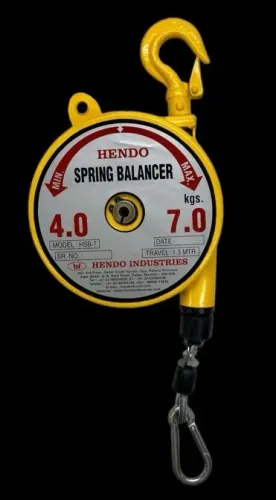
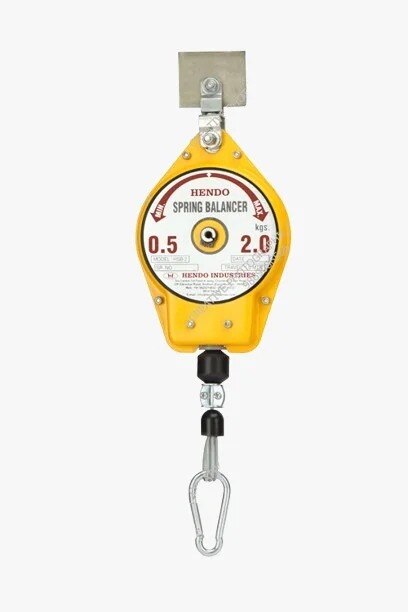
A flat-series spring balancer suits hand-operated tools that move repeatedly through a defined workstation, such as fastening guns, drills, riveters, inspection instruments, and light assembly tools. Select it for the complete suspended mass, including the tool, socket or bit, guard, hook, hose, electrical cable, and quick-change fixture.
| Station task | Flat-series fit | Use another system when |
|---|---|---|
| Hand fastening or drilling | Suitable if the tool reaches every fastening point within its usable travel | The tool needs powered positioning, torque reaction control, or more travel than the cable provides |
| Inspection, trim, or light assembly | Suitable for repeated operator movement with a controlled return | The suspended item is a component, fixture, or load that must be transported rather than held |
| Welding or adhesive application | Suitable only when the balancer’s temperature, spatter, dust, and cleaning limits permit it | Heat, welding spatter, wash-down, or chemical exposure exceeds the specified protection |
Do not use a spring balancer for an automotive plant as a hoist for engines, doors, panels, pallets, or people. Use a hoist, lift assist, manipulator, crane, or dedicated material-handling system for those loads.
For a flat series spring balancer for automotive plants in Pune, local stock and service help with spare springs, cable and hook kits, and inspection response, but they do not prove station suitability.
Confirm the nameplate and datasheet for minimum and maximum load, usable travel, tool dimensions, mounting height, installation clearance, hook type, cable diameter, mounting arrangement, and duty cycle. HSB-1 and HSB-2 are model names, not capacity standards.
How to compare HSB-1 and HSB-2 before selecting a model
Do not treat the model number as a capacity rating. Compare the manufacturer’s datasheet and nameplate for the exact units offered, then confirm the figures with the production tool, hose, fittings and mounting arrangement.
| Criterion | HSB 1 flat series spring balancer | HSB 2 flat series spring balancer | Evidence to record |
|---|---|---|---|
| Minimum and maximum load | Enter rated range | Enter rated range | Complete suspended mass, not tool mass alone |
| Usable cable travel | Enter usable stroke | Enter usable stroke | Required fastening, welding, inspection or assembly reach |
| Tool and unit dimensions | Enter body and tool-clearance limits | Enter body and tool-clearance limits | Interference with vehicle, fixture or operator |
| Mounting height and arrangement | Enter approved support and height | Enter approved support and height | Bracket, eye, clamp, clearance and anchor details |
| Duty cycle | Enter cycles, operating limits and reset requirements | Enter cycles, operating limits and reset requirements | Production cycles per shift and repeated retraction |
| Cable, hook and safety details | Enter cable diameter, hook type and retention device | Enter cable diameter, hook type and retention device | Nameplate and safety documentation |
Select the hsb 1 flat series spring balancer or hsb 2 flat series spring balancer only after the complete suspended load fits its range throughout the stroke. A tool that feels neutral when parked can become heavy at maximum reach if spring force does not cover that extension.
Run a station trial and document neutral feel, retraction speed, maximum extension, hook-latch access, vehicle clearance, accidental contact during return and behaviour after repeated cycles. Local stock, spare springs and service response in Pune support procurement; they do not prove suitability.
How to size the balancer for the real suspended load and working stroke
Start with the complete suspended mass, not the bare tool weight. Add the tool, socket or bit, guard, hook, hose, supported electrical cable, swivel, and quick-change fixture. This total defines the load the spring balancer for automotive plant must carry.
1. Weigh the assembled setup in its production configuration. Compare that mass with the manufacturer’s minimum and maximum load range on the nameplate or datasheet. Do not assume an HSB 1 flat series spring balancer or HSB 2 flat series spring balancer has a capacity implied by its model number.
2. Measure the working stroke from the parked position to the farthest fastening, welding, inspection, or assembly point. Add the required approach distance, then compare the result with usable cable travel.
Check the cable path at both ends; a nominal travel figure is useless if the hook reaches the vehicle before the operator reaches the joint.
3. Record the tool’s actual feel at minimum height, normal working height, and maximum extension. Set the balance within the specified spring range so the tool remains neutral at the operator’s main working position. A tool that floats beside the balancer can become heavy at full reach.
4. Confirm the selected unit’s mounting height, dimensions, clearance, hook arrangement, and duty-cycle rating against the station cycle time. Reject the selection if the combined mass exceeds the range, the required stroke exceeds usable travel, or repeated cycles cause slow retraction, cable slack, or noticeable operator lift.
What the Pune environment, mounting point, and safety system must support
A flat series spring balancer in Pune needs a mounting structure that carries the complete suspended mass without flexing. Verify the manufacturer’s mounting orientation, bolt size, hole pattern, minimum installation clearance, mounting height, cable travel, and hook access against the station layout.
Confirm that the usable travel reaches the fastening, welding, inspection, or assembly point without pulling the cable sideways.
Check the plant environment before approval:
- Protect the housing, spring, cable, and hook from welding spatter, grinding dust, paint mist, coolant, oil, and monsoon-related water ingress.
- Confirm the specified operating temperature, humidity, corrosion protection, and enclosure suitability from the datasheet; do not assume indoor installation is dry or clean.
- Route hoses and electrical cables so they do not rub on the vehicle, develop a sharp bend, or add unmeasured weight at full extension.
- Provide the manufacturer-specified safety device, such as a secondary retention chain, where the installation risk assessment requires one.
- Keep the return path clear so a released tool cannot strike an operator, vehicle, fixture, or glass panel.
Record the tool, socket or bit, guard, hook, hose, cable, and quick-change fixture mass at the working extension. The nameplate must state the applicable load range and travel; HSB-1 and HSB-2 are model names, not capacity standards.
During planned maintenance, inspect broken cable wires, kinks, hook deformation, latch operation, loose mounting, housing damage, abnormal spring noise, and reduced retraction force. Remove an erratic or damaged unit from service; increasing pull force is not a repair.
How to validate the purchase with a station trial
Approve the purchase only after the production tool, hose, fittings, and intended mounting arrangement complete representative station motions. A flat series spring balancer in Pune is suitable only when the trial proves control at the actual working reach, not merely that the unit can suspend the tool.
1. Record the complete suspended mass, model and nameplate data, mounting height, minimum and maximum working heights, cable travel, hook type, and installation clearance. Compare each figure with the manufacturer datasheet for the HSB 1 or HSB 2; model names do not establish capacity.
2. At the operator’s nearest and farthest positions, record whether the tool feels neutral, becomes heavy, or rises unexpectedly. Mark the actual fastening, welding, inspection, or assembly points and confirm that the available travel reaches all of them.
3. Run the tool through representative production cycles. Check retraction speed, cable stability, hook and latch access, interference with the vehicle, and accidental contact with the operator or bodywork during return.
4. Repeat the agreed cycle count and inspect the cable, hook, spring housing, mounting bolts, and fittings afterward. Record failures, drift in balance, noise, heat, and any change in retraction.
5. Add the site conditions to the approval record: dust, metal fines, welding spatter, humidity, wash-down exposure, cleaning restrictions, cable material and diameter, corrosion protection, spare springs, hook and cable kits, and service response time.
Ask Hendo Industries or the supplier to attach the signed trial sheet, safety documentation, inspection interval, and replacement-parts lead time to the purchase order. Local support does not replace evidence that the HSB 2 flat series spring balancer fits this station.
Related products
 | FLAT SERIES SPRING BALANCER FLAT SERIES SPRING BALANCER HSB-1 The HSB-1 Flat Series Spring Balancer by Hendo Industries is a compact and efficient lifting solution designed to improve productivity and reduce... View product → |
 | FLAT SERIES SPRING BALANCER FLAT SERIES SPRING BALANCER HSB-2 The FLAT SERIES SPRING BALANCER HSB-2 by Hendo Industries is a high-performance industrial balancing solution designed to support lightweight tools... View product → |
Frequently asked questions
Where does a flat-series spring balancer fit on an automotive line?
It fits hand-operated tools that move repeatedly through a defined workstation, including fastening guns, drills, riveters, and inspection instruments.
How should you compare the HSB-1 and HSB-2?
Compare their rated suspended-load ranges, working strokes, dimensions, mounting arrangements, and compatibility with the tool and fixture. Use the manufacturer’s current specification sheet for the exact limits.
How do you size a flat-series spring balancer?
Add the tool, socket or bit, guard, hook, hose, electrical cable, and quick-change fixture, then select a model whose rated range covers that complete suspended mass and required working stroke.
What must a Pune automotive plant provide before installation?
Provide a verified mounting point, suitable fasteners, clear tool travel, controlled hose and cable routing, and a secondary safety system that retains the balancer if the primary attachment fails.
Why run a station trial before buying?
A trial confirms that the tool reaches every fastening or inspection point, returns without excessive pull, clears nearby equipment, and remains comfortable throughout the operator’s full movement.