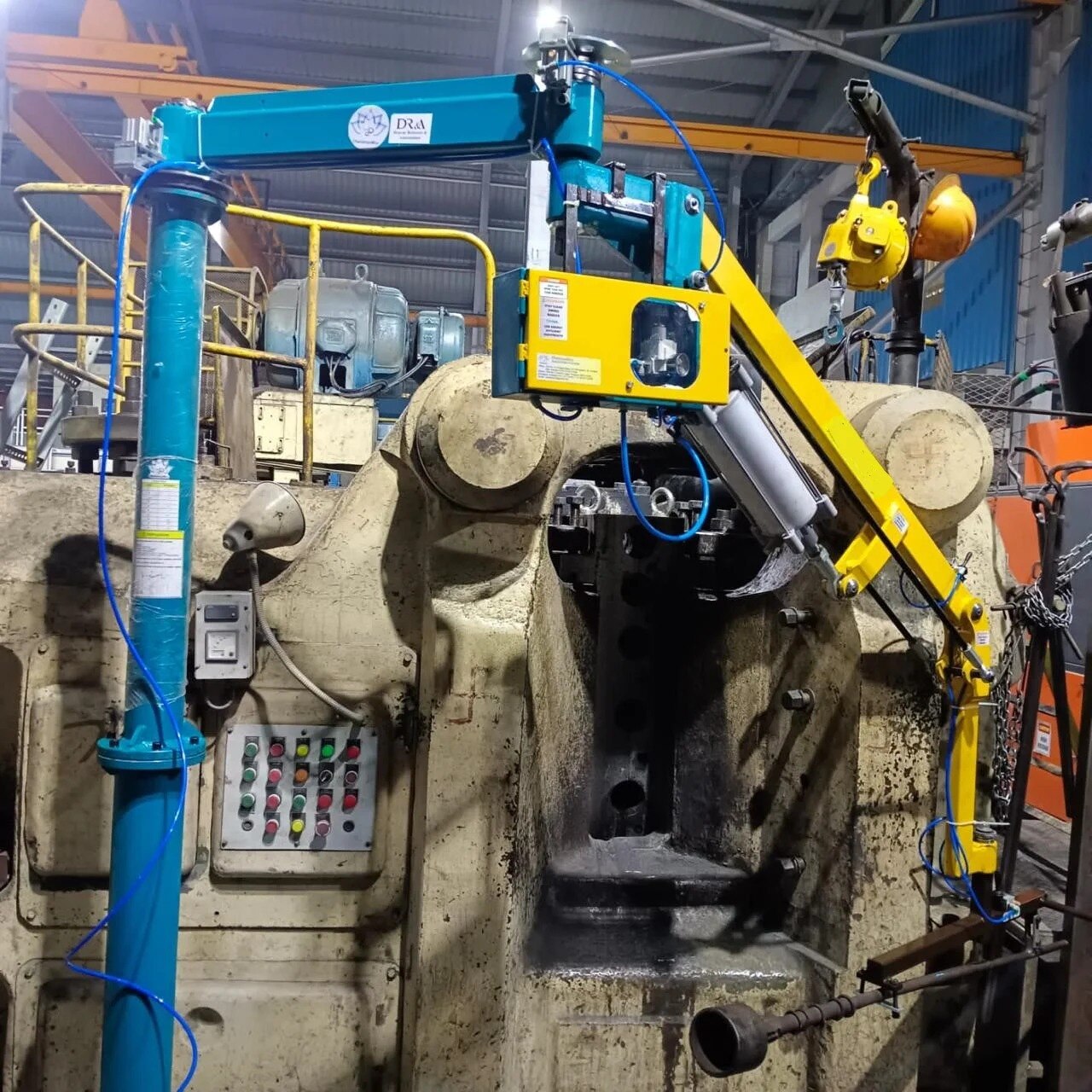
A manipulator earns its cost only when it completes the required handling cycle safely, repeatedly, and with less effort than the available alternatives. You will be able to calculate usable capacity, compare a DRA 50 kg manipulator with a DRA 80 kg manipulator, prepare a supplier brief, and judge the full industrial manipulator cost in Pune.
Key takeaways
- Choose capacity from the heaviest real load, reach, and end-effector weight.
- Compare cycle control, reach, installation, and safety—not rated capacity alone.
- Request load charts, layout drawings, commissioning scope, and service terms in Pune quotations.
- Run a measured production trial before approving the purchase.
What a 50 kg or 80 kg manipulator actually does during a cycle
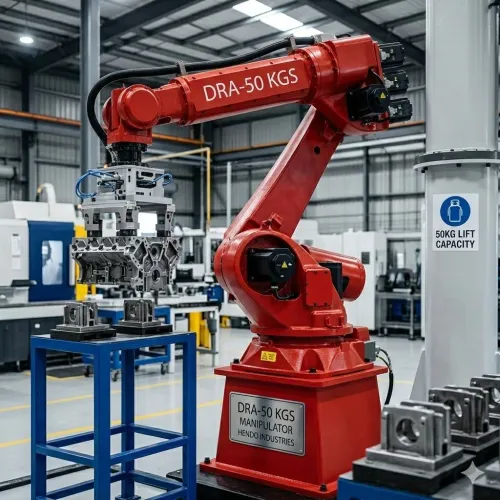
During a cycle, a manipulator for factory handling lets the operator guide a suspended part through pickup, transfer, positioning, and release without supporting its full weight. The operator controls the movement through a handle, pendant, or control valve while the end effector holds the part.
- Pick-up: The gripper, hook, or vacuum tool engages the approved pickup point and supports the load.
- Transfer: The operator moves the balanced part horizontally or vertically along the manipulator’s working envelope.
- Positioning: The operator aligns holes, faces, or fixtures while the mechanism carries the load.
- Release: The tool disengages only after the part is stable, with loss-of-power retention preventing an uncontrolled drop where specified.
The headline 50 kg or 80 kg rating is not the workpiece weight. Usable capacity equals rated payload minus the mass of the gripper, vacuum frame, hooks, adapters, hoses, cables, and permanently mounted tooling. A 50 kg manipulator fitted with a 12 kg tool leaves about 38 kg for the part before derating.
Reach, an offset centre of gravity, acceleration, and impact can reduce that allowance. The end effector can become the real constraint: confirm jaw opening, gripping force, vacuum reserve, surface condition, part temperature, and power-loss retention.
A 50 kg or 80 kg manipulator in Pune also needs its specified inlet pressure and airflow under load; a nominal 6 bar reading elsewhere in the plant proves little. An 80 kg unit is not automatically better if a correctly sized 50 kg system handles the cycle with greater control and lower installation cost.
How to choose between 50 kg and 80 kg capacity
Choose from the worst real cycle, not the average part weight. Add the end effector, hooks, adapters, fixtures, and any product variation to the load before comparing capacities. A 50 kg part with a 10 kg gripper is already a 60 kg handling system.
| Option | Best fit | Main checks |
|---|---|---|
| DRA 50 kg manipulator | Loads stay comfortably below 50 kg, with short reach, stable centre of gravity, moderate lift height, and smooth, frequent cycles | Confirm the load chart at the actual reach, load centre, vertical position, duty cycle, and tool mass |
| DRA 80 kg manipulator | Loads approach 50 kg, shift off-centre, use long reach or high lift, or involve impact, tilting, acceleration, or emergency stops | Verify mounting structure, exclusion zone, installation cost, and positioning response; extra capacity does not automatically improve accuracy |
| Either capacity | The gripper and control system match the part and process | Test jaw opening, gripping force, vacuum reserve, surface condition, temperature, power-loss retention, and release behaviour |
Reach changes the decision sharply. A 50 kg load at a 0.5 metre offset creates about 245 N·m of static moment; 80 kg at that offset creates about 392 N·m, before tooling or dynamic effects. Ask for derating or load-chart data for the full motion profile.
Choose the 80 kg model when the 50 kg unit would operate near its limit or lose control during repeated stops. Choose the 50 kg model when it leaves clear margin and its smaller structure supports faster, more accurate positioning.
Test the heaviest awkward part at maximum reach, lift height, cycle frequency, and required placement tolerance.
When a manipulator beats a hoist, crane, trolley, or manual handling
A manipulator for factory handling earns its cost when operators repeat awkward picks, transfers, and accurate placements throughout a shift. It is not automatically the cheapest method: compare the completed-cycle cost, including labour, fatigue, damage, utilities, maintenance, installation, and uptime.
| Method | Better choice when | Limitation |
|---|---|---|
| Hoist | You need occasional vertical lifting at fixed points | Slow positioning and load swing |
| Jib crane | Loads vary across a broad local work area | Needs structural support and operator control |
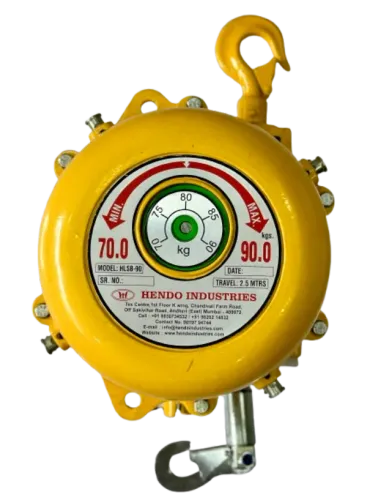
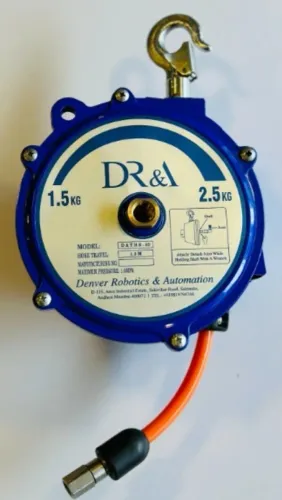
| Spring balancer | A hand tool needs weight relief through a short stroke | Not suited to transferring substantial parts |
| Push-pull trolley | Parts travel horizontally on a predictable route | Requires clear floors and manual positioning |
| Forklift | Pallets or heavy loads move between locations | Poor choice for precise workstation placement |
| Vacuum lifter | The surface is smooth, sealed, and accessible | Vacuum loss and porous or hot surfaces create risk |
| Manual handling | Loads are light, occasional, close, and easy to grip | Fatigue and injury exposure rise with repetition |
A manipulator becomes economical when its controlled motion removes several handling steps and lets one operator position the part accurately. Evaluate the gripper with the machine: jaw opening, gripping force, vacuum reserve, centre of gravity, part temperature, and loss-of-power retention can decide whether the system works.
Choose a correctly sized 50 kg unit for a 50 kg job when tooling leaves adequate usable capacity and fine positioning matters. An 80 kg unit is worth its extra structure and installation cost only when reach, tooling, impact, or future loads justify it.
What to include in a Pune quotation and installation review
Before comparing a 50 kg or 80 kg manipulator in Pune, require a line-item quotation and a site-specific technical review. An advertised industrial manipulator cost in Pune is not comparable when one supplier excludes installation steel and commissioning.
1. Send the supplier a part drawing showing dimensions, material, centre of gravity, weight distribution, pickup points, gripping surfaces, and permissible contact areas. Ask whether the quoted payload includes the gripper, hooks, fixtures, adapters, and hoses.
2. State the required cycle time, cycles per hour, shifts, operator position, longest reach, working radius, lift height, vertical stroke, rotation, tilt, and positioning accuracy. Request the payload-at-reach or derating chart for the actual motion profile, including acceleration, impact, emergency stops, and off-centre loads.
3. Make the quotation separate the manipulator, runway or column, mounting steel, foundation and anchor bolts, electrical or pneumatic drops, FRL and air-preparation equipment, controls, guarding, safety interlocks, installation, commissioning, and operator training. Confirm who supplies drawings and accepts responsibility for the mounting structure.
4. Specify control method, pendant or handle controls, power and compressed-air pressure, air consumption, and load retention after air or power loss. Ask for warranty exclusions, local response time, annual maintenance, and stocked seals, valves, bearings, sensors, and gripper spares.
Ask Hendo Industries, or any Pune supplier, to state these assumptions in writing; otherwise a lower quotation can conceal a higher operating cost. Score guaranteed service response beside purchase price.
Related products
 | Manipulator The DRA-50 KGS Manipulator by Hendo Industries is a versatile and high-performance material handling solution designed to simplify lifting and... View product → |
 | Manipulator The DRA-80 KGS Manipulator by Hendo Industries is a robust and efficient material handling solution designed to streamline industrial operations. View product → |
How to prove the purchase is worth it before production
Do not approve the purchase from a demonstration with an easy load. Run an acceptance test on the heaviest, most awkward part, using the real end effector, longest reach, highest lift, and intended production cycle time.
1. Record completed cycles per hour, operator count, compressed-air or electricity use, and operator effort. Include awkward posture, force at the controls, and fatigue across a full shift.
2. Check positioning repeatability at pickup, transfer, and release. Measure drift after release, especially with an off-centre load, and record rejected or damaged parts.
3. Remove air and electrical power during a controlled failure-retention test. The load must remain secured or descend into a defined safe position. Test collision behaviour, emergency stops, guarding, restart logic, and safe parking when unattended.
4. Request the exact payload-at-reach curve, stroke, working radius, control method, and utility requirements. “DRA 50 kg manipulator” and “DRA 80 kg manipulator” are not complete specifications.
5. Price seals, valves, bearings, sensors, gripper spares, planned maintenance, local response time, guaranteed service response, and expected uptime. A stoppage can cost more than the capacity upgrade.
Calculate cost per completed cycle as total ownership cost divided by good cycles: purchase and installation, maintenance, energy, labour, downtime, and rejected parts. Compare that figure with the existing method across every shift. This makes an industrial manipulator cost in Pune comparable on value, not headline price.
Frequently asked questions
What does a 50 kg or 80 kg manipulator do during a cycle?
It supports a suspended part during pickup, transfer, positioning, and release while the operator guides its movement through a handle, pendant, or control valve.
How do you choose between a 50 kg and 80 kg manipulator?
Use the heaviest complete load, including the end effector, then check reach, movement path, working height, balance, and future load requirements.
When is a manipulator better than a hoist, crane, trolley, or manual handling?
Choose a manipulator when operators need controlled, repeatable positioning close to the workstation rather than simple vertical lifting or occasional transport.
What should a Pune manipulator quotation include?
Request rated capacity, working envelope, mounting details, end-effector scope, safety features, installation, commissioning, training, warranty, service response, and exclusions.
How can you prove a manipulator purchase is worthwhile before production?
Measure current cycle time, handling effort, defects, incidents, staffing, and downtime, then compare them with results from a representative production trial.