A 50 kg rating does not mean the arm can carry every 50 kg workpiece at every reach, angle, or handling speed. You will be able to test the complete load, compare a DRA-50 KGS Manipulator with a DRA-80 KGS Manipulator, check your workshop’s structure and utilities, and define an acceptance test before selecting an industrial manipulator for workshops.
Key takeaways
- Subtract grippers, clamps, slings, and tooling from the 50 kg rating.
- Check load capacity at your actual reach, wrist moment, and handling height.
- Choose an 80 kg manipulator when tooling and off-centre loads consume the margin.
- Prove the selected manipulator on your heaviest, awkwardest production parts.
Start with the real load, reach, and handling cycle
A 50 kg rating does not mean you can lift a 50 kg workpiece at every arm position. Calculate usable capacity by subtracting the gripper, hook, clamps, slings, and tooling from 50 kg, then check the manufacturer’s load-versus-reach and wrist-moment chart for the remaining load.
Before approving a 50 kg manipulator for engineering workshops in Pune, record:
- Workpiece mass, dimensions, centre of gravity, and inertia
- Required minimum and maximum reach
- Vertical lift and horizontal travel
- Lifts or transfers per hour and per shift
- Required positioning accuracy and operator force
- Fixture clearances, mounting height, and approach direction
Test the actual part through its complete handling cycle: pick-up, rotation, insertion, placement, release, and return. A compact, centrally balanced demonstration load can hide instability when your component has an offset centre of gravity, long dimensions, sharp edges, or a large wrist moment.
Ask for a demonstration at the furthest reach and highest handling frequency you will use, not only at the arm’s most favourable position. Watch for sag, drift, swing, excessive push force, contact with fixtures, and loss of control after release.
An industrial manipulator for workshops supports guided movement; it does not automatically provide robot-like accuracy or collision detection.
If the chart shows insufficient capacity at your real radius, do not treat the model label as a margin of safety. Recalculate with the loaded tooling and actual cycle, then compare a larger manipulator or a simpler handling device.
Choose between 50 kg, 80 kg, and simpler handling equipment
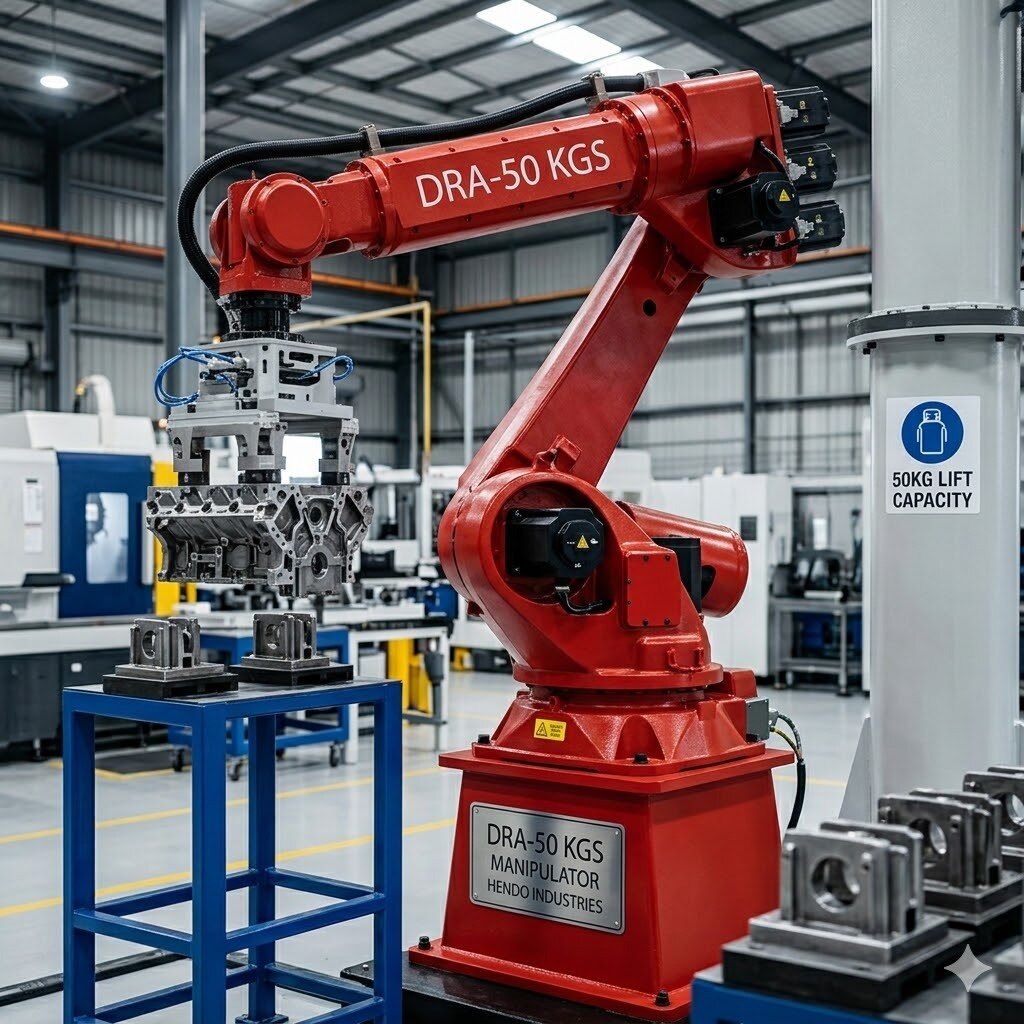
Choose the DRA-50 KGS Manipulator when the complete handled load stays comfortably below its load-versus-reach limit, including gripper, hook, slings, clamps, and off-centre moments.
The DRA-80 KGS Manipulator justifies its extra capacity when heavier parts, eccentric centres of gravity, longer reach, fixture changes, or future production would push a 50 kg unit close to its limit.
| Option | Practical fit | Choose it when |
|---|---|---|
| DRA-50 KGS Manipulator | Local lifting, rotation, and alignment of moderate loads | The load, reach, vertical travel, cycle rate, and required operator force fit its chart |
| DRA-80 KGS Manipulator | Higher payload or greater moment margin | Parts repeatedly approach 50 kg, the tooling is heavy, or future loads demand reserve capacity |
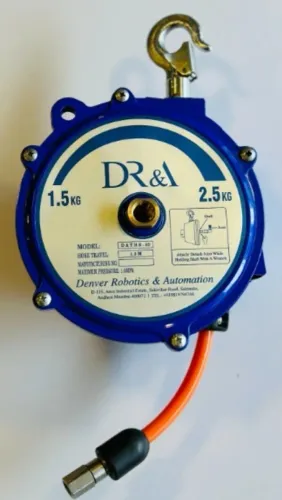
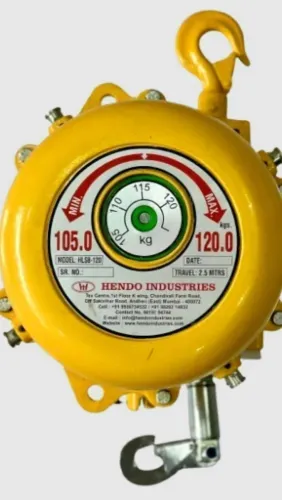
| Spring balancer | Suspended hand-tool support | The main need is reducing tool weight, not positioning a component |
| C-track trolley | Horizontal movement along a fixed route | Loads travel repeatedly between defined workstations |
| Push-pull trolley | Floor-level load movement | You need transport, not assisted lifting or precise elevation |
Do not buy the 80 kg model merely for a larger label. Stronger mounting, larger actuators, greater clearance, and higher purchase and installation effort can reduce responsiveness and complicate the workspace. Ask for the rated load at your actual radius and wrist moment.
Manipulator benefits are strongest when operators repeatedly lift, rotate, or align parts between waist and shoulder height. Choose another device when the load moves only a few times per shift, cannot be gripped securely, or must travel long distances.
A manipulator supports guided handling; it does not automatically provide robot-like accuracy, collision detection, or a safe path around fixtures.
Check the workshop before you check the catalogue
A 50 kg rating does not tell you whether your workshop can carry, power, or safely use the machine. Check the installation site before comparing models.
1. Verify the physical envelope. Mark the arm’s maximum reach, vertical travel, rotation path, loading point, and return path on the floor. Check doorways, columns, cranes, mezzanines, stored materials, lighting, emergency exits, and operator clearance. An industrial manipulator for workshops becomes a collision hazard if its swept area overlaps a walkway or another machine.
2. Verify the mounting structure. Identify whether the unit will attach to a ceiling, column, jib, or floor-mounted base, then obtain a structural calculation for the combined static load, dynamic load, and overturning moment.
A beam or mezzanine that appears substantial is not automatically suitable; the manipulator’s nominal 50 kg or 80 kg rating does not certify the building structure.
3. Verify utilities and conditions. For a pneumatic unit, record the available minimum and maximum pressure, peak air consumption, hose size, filtration, and water separation. Inspect condensate drains and moisture control before monsoon operation in Pune, and confirm what the arm does after pressure loss.
A quotation for a 50 kg manipulator for engineering workshops in Pune should state the mounting arrangement, guarding, environmental limits, failure mode, and acceptance-test method. Test the actual pick, rotation, insertion, placement, release, and return cycle—not a compact, centrally balanced substitute. Include the gripper, coupler, sensors, hoses, and cables in the suspended mass.
Match the manipulator to the task and the risk
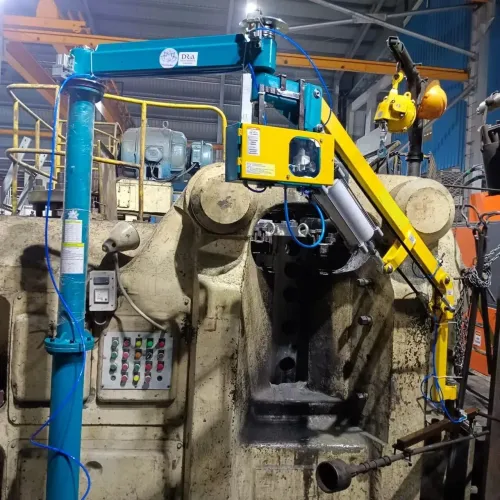
A 50 kg manipulator fits repeated lifting, rotation, and alignment of components whose complete handled mass stays below 50 kg after adding the gripper, hook, clamps, slings, and tooling. It is strongest at waist-to-shoulder height, where workers repeatedly position parts with controlled accuracy.
| Workshop task | Suitable equipment | Reason |
|---|---|---|
| Lift, rotate, and align dies, housings, or fabricated parts | 50 kg manipulator | Reduces repeated lifting and supports precise positioning |
| Hold a suspended drill or torque tool | Spring balancer | Balances the tool rather than handling components |
| Move loads along a fixed horizontal route | C-track trolley | Provides travel without a manipulator’s lifting mechanism |
| Push loads across the floor | Push-pull trolley | Suits transport, not suspended positioning |
Prove the manipulator benefits with a before-and-after trial on the real part and full cycle. Record push and pull force, reach distance, shoulder and wrist posture, positioning accuracy, handle height, and corrective movements; a lower lifting force is not an improvement if the operator holds a twisted wrist or pushes sideways for longer.
Check every hazard before approval:
- Crushing and shearing at the arm, wrist, gripper, fixture, and nearby machinery
- Dropped loads, hose rupture, pressure loss, and unexpected restart
- Operator access to the swept envelope and emergency stop position
For a pneumatic industrial manipulator for workshops, specify pressure limits, peak air consumption, filtration, water separation, hose size, and pressure-loss behaviour. Inspect condensate management during Pune’s monsoon. Verify the mounting structure for static and dynamic loads plus overturning moment, then apply ISO 12100 risk assessment and the applicable local rules.
Specify the duty envelope and prove it on your parts
Do not approve a quotation that says only “50 kg manipulator for engineering workshops in Pune.” Ask for the complete duty envelope: payload including gripper and slings, load-versus-reach chart, centre of gravity, dimensions, vertical and horizontal travel, rotation, positioning accuracy, cycles per hour, and mounting loads.
1. Request the quotation to state the DRA-50 KGS Manipulator or DRA-80 KGS Manipulator’s maximum wrist moment, allowable offset load, mounting arrangement, overturning moment, clearances, guarding, and safe behaviour after air or power loss. Include minimum and maximum air pressure, peak consumption, filtration, water separation, hose size, and monsoon condensate control.
2. Require a demonstration using your heaviest and most awkward part, with its actual gripper. Run pickup, rotation, insertion, placement, release, and return at production speed; test the offset centre of gravity, sharp edges, long dimensions, and maximum reach.
Hendo Industries should record operator force, cycle time, sway, and positioning errors rather than demonstrate a compact balanced weight.
3. Put acceptance criteria in writing: every tested part completes the cycle without drift, collision, dropped load, excessive effort, or instability. Have the supplier verify the ceiling, column, jib, or floor base for combined static and dynamic loads before installation; the arm rating does not certify your beam.
4. Demand a maintenance plan naming inspection intervals, air-filter and water-separator service, lubrication points, hose and seal checks, load-test requirements, failure response, spare parts, and technician response time. Reject the purchase if the usable load at your reach is not documented.
Related products
 | Manipulator The DRA-50 KGS Manipulator by Hendo Industries is a versatile and high-performance material handling solution designed to simplify lifting and... View product → |
 | Manipulator The DRA-80 KGS Manipulator by Hendo Industries is a robust and efficient material handling solution designed to streamline industrial operations. View product → |
Frequently asked questions
How do you calculate the usable capacity of a 50 kg manipulator?
Subtract the gripper, hook, clamps, slings, and tooling from 50 kg, then check the load-versus-reach and wrist-moment chart for the remaining load.
When should a Pune workshop choose an 80 kg manipulator instead of a 50 kg model?
Choose an 80 kg model when the workpiece, tooling, off-centre load, reach, or handling cycle exceeds the 50 kg model's verified duty envelope.
What should you inspect before selecting an industrial manipulator for workshops?
Check floor condition, mounting space, aisle width, overhead clearance, power or air supply, operator position, part presentation, and the full handling path.
How can you verify that a manipulator suits your parts?
Specify the load, centre of gravity, reach, rotation, cycle frequency, gripping method, and safety risks, then run a practical trial using your actual parts and tooling.