A suspended pneumatic tool is only as reliable as its anchor, hose route, load match and working envelope. By checking the complete assembly and testing it at the workstation, you can compare Pune suppliers on engineering evidence rather than a model name or unit price.
Key takeaways
- Mount the suspender to a verified structural member, never a thin service panel.
- Weigh the tool, hose, fittings and accessories as one suspended load.
- Compare DATHS-15, DATHS-25, DATHS-35 and DATHS-50 at their load boundaries.
- Test hose reach, return behaviour and drop protection before production use.
How to install a hose suspender above an automotive workstation
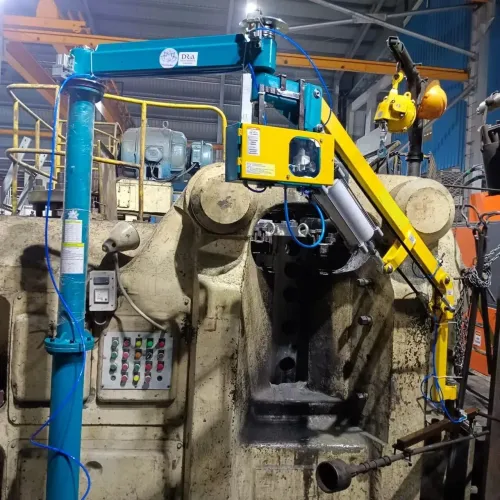
A correct overhead installation runs from a verified structural member to the suspender, through controlled hose routing, and ends at the tool without using the hose as a lifting attachment. Position the suspender above the workstation’s working zone, not above a thin service panel or unverified trolley.
1. Confirm that the beam, gantry, trolley rail, or fabricated bracket carries the combined static mass plus forces from pulling, stopping, starting and accidental release. Use mounting hardware rated for the structure, and tighten it to the specified torque.
2. Fit the suspender so its body stays aligned with the operator’s pull. Provide clearance from vehicle roofs, underbody fixtures, lighting, conveyors and moving equipment across the full travel.
3. Attach a positive secondary restraint directly to the structural support. Set it to limit the tool’s drop distance if the suspender or primary attachment fails. Do not attach this restraint to the air hose or rely on a hose connection for load-bearing safety.
4. Route the hose in a smooth loop with no sharp bend at the suspender outlet. Keep it clear of pinch points, rotating parts and vehicle edges, then fit the actual coupler, whip hose and tool without creating continuous side-load or twist.
5. Pull the tool through its entire travel before production use. Check operator force at the beginning, middle and end, rebound at release, hose drag, collision with fixtures and alignment during torque-tool operation.
For an air tool hose suspender in Pune, record the complete suspended assembly and have the supplier confirm the rated range, mounting arrangement and trial results for the actual workstation.
Measure the complete suspended load before choosing a model
A 1.8 kg impact wrench is not a 1.8 kg suspended load. Weigh the complete assembly in its production configuration, because the hose, coupler and fittings add mass that the suspender must support.
Include these items in the measurement:
- Tool body, battery or reaction arm, if fitted
- The full hose length hanging from the suspender
- Quick coupler, whip hose, fittings and balancer attachment
- Temporary accessories such as sockets, guards or tool trays
- Downward force created when the hose is stretched, bent or pulled to the farthest working position
| Component | How to measure it | Add to the working-load record |
|---|---|---|
| Tool | Weigh the ready-to-use tool | Full tool mass |
| Hose | Weigh the installed length, including end fittings | Hose mass |
| Connection hardware | Weigh coupler, whip hose and attachment | Hardware mass |
| Accessories | Weigh every item that travels with the tool | Accessory mass |
| Pulling force | Record the peak force during the farthest reach | Supplier-confirmed allowance |
Add the measured masses, then give the supplier the highest total and the lowest operating position. The suspender’s stated working range must cover both without upward pull, tool drop or poor control.
Do not treat DATHS 15 supplier in Pune or DATHS 25 supplier in Pune as proof of capacity; request the datasheet, load range and spring-setting method before ordering. A lightly rated unit pulls upward, while an oversized unit resists repositioning.
Compare DATHS-15, DATHS-25, DATHS-35 and DATHS-50 at the boundaries
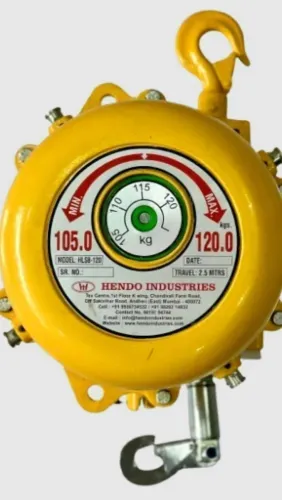
A measured load of 1.5 kg, 2.5 kg or 3.5 kg sits on a boundary, not safely inside a model range. Treat DATHS-15, DATHS-25, DATHS-35 and DATHS-50 as candidate bands until the supplier’s datasheet states minimum and maximum working load, stroke, hose length, mounting arrangement and safety factor.
| Model | At the boundary | When to move up |
|---|---|---|
| DATHS-15 | At 1.5 kg, use it only when the confirmed working range covers the complete assembly at every position. | Choose DATHS-25 if end travel pulls upward, hose routing adds drag, or the tool needs precise alignment. |
| DATHS-25 | At 2.5 kg, confirm that the load does not sit at the spring’s limit during extension. | Choose DATHS-35 for long travel, heavier couplers or repeated torque-tool use. |
| DATHS-35 | At 3.5 kg, accept it only after a trial confirms neutral support through the full stroke. | Choose DATHS-50 when hose side-load, rebound or accessories consume the available range. |
| DATHS-50 | Use it for the next confirmed load band, not as a substitute for missing data. | Reject the choice if its minimum working load pulls the lighter tool upward. |
Short travel at a straight assembly station suits the smallest confirmed band. Long travel in an underbody bay increases hose drag and end-of-stroke force, so test the actual routing. Impact wrenches and grinders need reaction-force control; torque-controlled tools need alignment without continuous side-load.
Ask a daths 15 supplier in Pune, daths 25 supplier in Pune or daths 50 supplier in Pune to document the complete load range and test force at the beginning, middle and end of travel.
Check reach, hose behaviour and drop protection before production use
A suspender suits the workstation only when the tool reaches every fastening point without end-of-travel pull, hose snagging or uncontrolled drop risk. Test the actual tool, coupler, hose length and fittings, not an empty suspender.
| Workstation | Movement check | Hose-routing check | Failure sign |
|---|---|---|---|
| Assembly line | Confirm vertical travel, swivel or trolley movement, end stops and cycles per shift | Keep the hose clear of fixtures, vehicle panels and operator pathways | Tool rebounds, pulls upward or strikes the body |
| Underbody bay | Test the full overhead-to-fastener reach around lifts and vehicle edges | Check bend radius, crushing at the balancer and abrasion against chassis parts | Hose catches when the operator changes position |
| Service station | Repeat movements across the vehicle’s full service area | Check slack, coupler position and contact with hot or sharp surfaces | Hose drags, twists or restricts tool rotation |
Measure operator force at the beginning, middle and end of travel. Include the worst-case routing and run enough cycles to represent one shift; static inspection will not reveal rebound or interference.
Before production use, verify these drop controls:
- Fit a secondary restraint to structural support, independent of the hose and primary balancer attachment.
- Limit the tool’s drop distance with the restraint; never treat a hose connection as load-bearing protection.
- Inspect hose routing for sharp bends, crushing, abrasion and hot-surface contact, using ISO 4414 as the pneumatic safety reference.
An air tool hose suspender in Pune is suitable only when these trial results match the supplier’s declared working envelope and duty cycle.
What to require from an air tool hose suspender supplier in Pune
Require a technical offer, a witnessed trial and a written after-sales plan before issuing the purchase order. An air tool hose suspender supplier in Pune must rate the complete suspended mass: tool, hose, coupler, fittings, whip hose, balancer attachment and temporary accessories.
| Evidence | Request | Reject if |
|---|---|---|
| Technical offer | Datasheet, dimensional drawing, minimum and maximum working load, vertical travel, hose length, mounting hardware, safety factor, hose-pressure rating and duty-cycle limit | The supplier gives only “DATHS 50” or a catalogue weight |
| Trial record | Operator-force readings at the start, middle and end of travel using your tool, actual coupler and worst-case hose routing | It shows only a static bench inspection |
| Service plan | Replacement springs and hoses, compatible couplers, inspection intervals, warranty exclusions and response times | Parts are non-standard or availability is undefined |
Your request for quotation should also require the effective working envelope: horizontal reach, swivel or trolley movement, bend-radius allowance, end-stop behaviour and expected cycles per shift. Nominal hose length alone does not prove usable reach.
- Record the complete assembly mass at its lowest and highest operating positions; confirm that the rated range neither lets the tool drop nor pulls it upward.
- During the trial, check rebound, end-of-travel pull, vehicle-body interference and fixture collisions.
- Ask any DATHS 50 supplier in Pune to state these figures on the offer, not merely in a verbal assurance. Hendo Industries can be compared on the same evidence, including replacement-part availability and inspection instructions.
Related products
 | AIR TOOL HOSE SUSPENDER AIR TOOL HOSE SUSPENDER- DATHS-15 The AIR TOOL HOSE SUSPENDER – DATHS-15 (0.5Kg-1.5Kg) by Hendo Industries is a lightweight and efficient industrial solution designed to support... View product → |
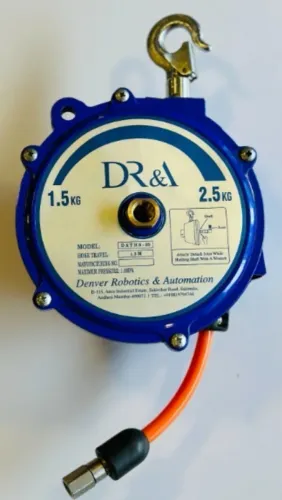
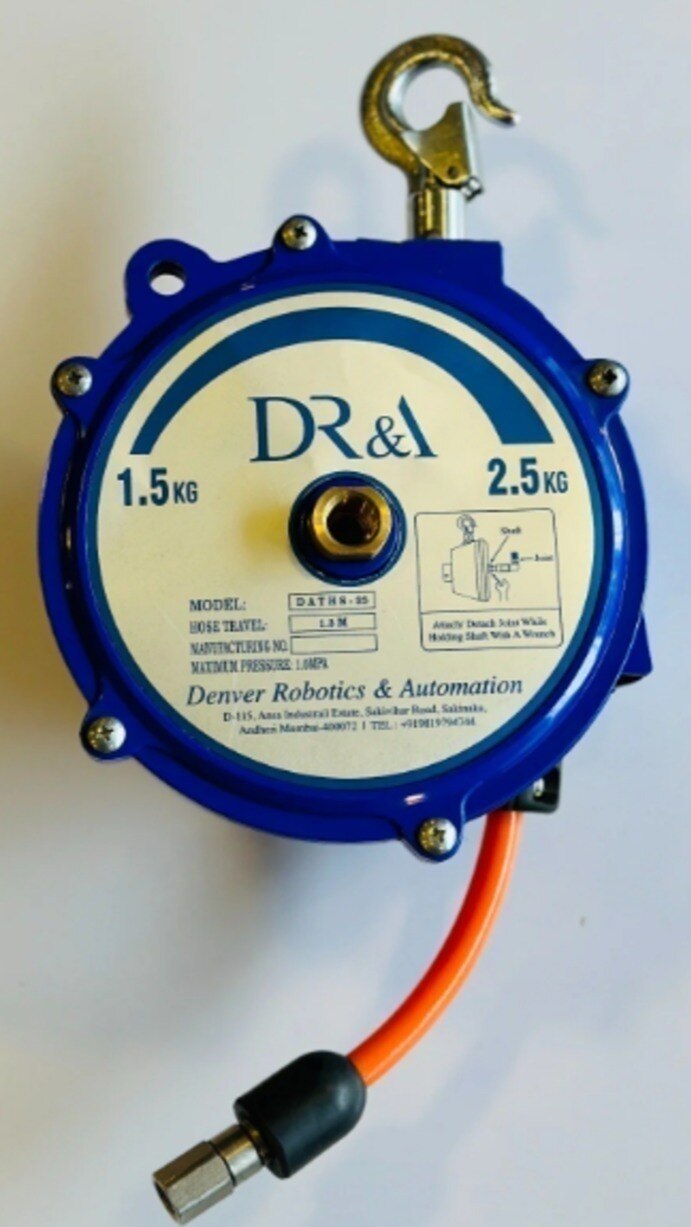
 | AIR TOOL HOSE SUSPENDER AIR TOOL HOSE SUSPENDER- DATHS-25 The AIR TOOL HOSE SUSPENDER – DATHS-25 (1.5Kg-2.5Kg) by Hendo Industries is a compact and efficient solution designed to support pneumatic tools and... View product → |
Frequently asked questions
How do you install a hose suspender above an automotive workstation?
Mount it to a verified structural member above the working zone, route the hose without sharp bends, and connect the tool without using the hose as a lifting attachment.
What must you measure before choosing a hose suspender model?
Measure the complete suspended load, including the tool, hose, fittings, couplers, balancer attachments and any accessories used during production.
How do DATHS-15, DATHS-25, DATHS-35 and DATHS-50 differ?
Compare each model against the complete measured load and its operating boundary rather than selecting by tool weight alone. Check the supplier’s stated capacity and reserve before installation.
What should you check before production use?
Check working reach, hose return and pull behaviour, routing clearance, attachment security and drop protection under the actual workstation conditions.
What should you require from an air tool hose suspender supplier in Pune?
Ask for the model’s load range, installation instructions, mounting requirements, reach information, inspection guidance, replacement parts and support for commissioning the installation.
Related products
 | AIR TOOL HOSE SUSPENDER AIR TOOL HOSE SUSPENDER- DATHS-35 The AIR TOOL HOSE SUSPENDER (2.5Kg-3.5Kg) DATHS-35 by Hendo Industries is a reliable and efficient industrial solution designed to support pneumatic... View product → |
 | AIR TOOL HOSE SUSPENDER AIR TOOL HOSE SUSPENDER- DATHS-50 The Air Tool Hose Suspender (3.5Kg-5.0Kg) DATHS-50 by Hendo Industries is a highly efficient industrial solution designed to support air tools and... View product → |