
Choosing by the component’s weight alone can put an undersized trolley, hoist, beam, or floor under load. You will be able to calculate the complete suspended weight, apply a practical operating margin, and match the trolley to the runway, travel conditions, workspace, and handling frequency.
Key takeaways
- Count the trolley, hoist, tool, hook, rigging, and payload.
- Choose capacity above the complete suspended load, not just the payload.
- Allow more margin for frequent travel, uneven floors, and impact.
- Verify beam flange size, trolley rating, and every system component.
Start with the Complete Suspended Load, Not the Payload
Calculate push pull trolley capacity from the complete suspended load, not only the material being moved. To decide which push pull trolley size for factory load, weigh or verify every item hanging from the trolley and compare the total with the manufacturer’s marked working load limit (WLL).
Include:
- Payload, fixture, die, or component
- Hoist, balancer, hook block, and lifting hook
- Slings, shackles, eyebolts, and spreader bars
- Permanently suspended tooling, cables, and attachments
- Any adapter frame or lifting beam below the trolley
A 500 lb (227 kg) quarter-ton trolley is not suitable for a 500 lb payload if the hoist and rigging add another 80 lb. That setup requires more than 580 lb of rated capacity, before applying the specified design factor or operating margin. In U.S.
catalogues, half-ton commonly means 1,000 lb (454 kg), and one-ton means 2,000 lb (907 kg); “ton” does not automatically mean metric tonne.
Check the complete system’s weakest WLL: trolley, beam, hooks, fasteners, lifting point, and floor-supported structure. Record the load’s dimensions and centre of gravity because an offset load can increase wheel and beam forces even when its scale weight fits.
A push trolley is for operator-applied hand movement; do not pull it with a forklift, tugger, winch, or powered vehicle unless its rating specifically covers those longitudinal and side loads.
Adjust the Choice for Travel, Frequency, and Floor Conditions
A trolley that meets the load rating is the wrong choice when the route, floor, or duty cycle demands more hand force than an operator can safely apply. Long travel, frequent starts and stops, gradients, and poor floor conditions can turn a nominally adequate push pull trolley capacity into an ergonomic failure.
| Condition | Why the rated trolley becomes unsuitable | What to check |
|---|---|---|
| Long or frequent travel | Rolling resistance accumulates, increasing fatigue and loss of control | Hand force over the full route and number of movements per shift |
| Inclined travel | Gravity adds a continuous load; the trolley can run away when released | Slope, braking or restraint requirements, and manufacturer approval |
| Damaged or contaminated runway | Debris, corrosion, or damaged wheels can cause binding and flange rubbing | Wheel condition, rail cleanliness, alignment, and lubrication |
| Misaligned beam sections | The trolley can skew, bind, or foul the flange despite adequate capacity | Joint alignment, flange width, beam profile, and side-plate gap |
| Low headroom | A larger trolley can foul the beam or reduce hook clearance | Trolley depth, wheel engagement, hook height, and obstructions |
For repeated handling, test the actual assembly with its payload, hoist, slings, and lifting point. Do not solve excessive force by upsizing alone: a heavier trolley can increase headroom loss and still bind on an incompatible beam.
A push trolley is for operator-applied force, not a forklift, tugger, winch, or powered vehicle, unless specifically rated for that method.
Compare Quarter-Ton, Half-Ton, One-Ton, and Two-Ton Options
A quarter-ton push pull trolley is rated for 500 lb (227 kg) in U.S. catalog terms; a half-ton push pull trolley is rated for 1,000 lb (454 kg), and a one-ton push pull trolley for 2,000 lb (907 kg). The marked working load limit controls, because “ton” does not automatically mean metric tonne.
| Option | Capacity | Wheel configuration | Suitable load type | Manoeuvrability | Clearance |
|---|---|---|---|---|---|
| Quarter ton | 500 lb / 227 kg | Compact wheels and frame | Light tools, fixtures, small dies, and components | Easiest hand travel and direction changes | Usually the smallest beam width and headroom penalty |
| Half ton | 1,000 lb / 454 kg | Larger wheels or wheel assemblies | Medium fixtures, tooling, and suspended equipment | Still responsive, but heavier to start and stop | More frame depth; check flange and beam clearance |
| One ton | 2,000 lb / 907 kg | Heavier wheel assemblies with greater load distribution | Hoists, substantial dies, and heavy components | Higher hand force and slower repositioning | Larger body can foul the beam or reduce hook height |
| Two ton | Two-ton class; verify the marked WLL | Largest wheels and frame in this group | Heavy assemblies and frequent high-load handling | Least agile; pushing effort rises sharply | Greatest headroom and beam-fit penalty |
Compare the complete suspended load, not just the material. A 600 lb process load plus a 100 lb hoist and 25 lb of rigging totals 725 lb, making a quarter-ton trolley undersized.
An inclined runway changes the choice: load can roll downhill, so a brake, geared trolley, chock, or engineered restraint may be necessary instead of simply increasing capacity.
Choose the Smallest Size That Leaves a Real Operating Margin
Select the smallest trolley whose marked working load limit exceeds the complete suspended load with a documented operating margin.
A quarter ton push pull trolley is nominally rated at 500 lb (227 kg), a half ton push pull trolley at 1,000 lb (454 kg), and a one ton push pull trolley at 2,000 lb (907 kg). The manufacturer’s WLL controls; “ton” does not automatically mean metric tonne.
| Option | Appropriate use | Undersized or unnecessarily large when |
|---|---|---|
| Quarter ton | Light dies, fixtures, tools, and small components whose payload plus hoist and rigging stays well below 500 lb | The complete suspended load reaches 500 lb, or the margin disappears during repeated handling |
| Half ton | Loads comfortably below 1,000 lb, including assemblies that exceed a quarter-ton rating but do not approach the half-ton limit | A one-ton load is near the limit, or a quarter-ton unit already provides adequate capacity and clearance |
| One ton | Heavy dies, moulds, or assemblies whose complete suspended load needs capacity above the half-ton range | The load is light enough that extra trolley mass, reduced headroom, or poor beam fit creates a new problem |
A 600-lb process load plus a 100-lb hoist and 25 lb of rigging totals 725 lb, so a quarter-ton trolley is undersized. That does not automatically make a half ton push pull trolley correct: check its margin, beam fit, travel frequency, and headroom.
For which push pull trolley size for factory load, treat a slope separately. A lightly loaded trolley can roll away on an incline; use a geared trolley, brake, chock, or engineered restraint when required. Upsizing capacity alone will not control runaway movement.
Verify the Beam and the Complete Handling System Before Ordering
After choosing a capacity, confirm that the trolley fits the runway and that the complete handling system—not just the trolley—has adequate safe working load.
1. Measure the beam or monorail: flange width, flange thickness, beam depth, profile, curvature, and any tapered sections. Compare these measurements with the trolley’s minimum and maximum adjustment range. Ask Hendo Industries for the exact fit range for the model you are considering; a nominal one-ton rating does not guarantee compatibility.
2. Check the structure for the combined trolley, hoist or balancer, hook block, slings, shackles, spreader bar, payload, and permanently attached equipment. Have an engineer verify beam bending, wheel reactions, fasteners, hangers, end stops, runway supports, and building connections. Include impact from starting and stopping, plus eccentric loading.
3. Confirm the complete setup’s WLL and design factor. Capacity markings are safety controls: OSHA requires an overhead crane’s rated load to be plainly marked on each side, and the load must not exceed that rating outside controlled testing. Mark the installed system clearly.
4. Confirm level travel, permitted gradients, track curves, available headroom, and the hand force required across the actual floor condition. Do not use vertical capacity to justify side pulling; an off-centre or horizontal pull can twist the trolley and overload one flange or wheel.
This sequence answers which push pull trolley size for factory load without treating the push pull trolley capacity as permission to exceed the beam or lifting-point limits.
Related products
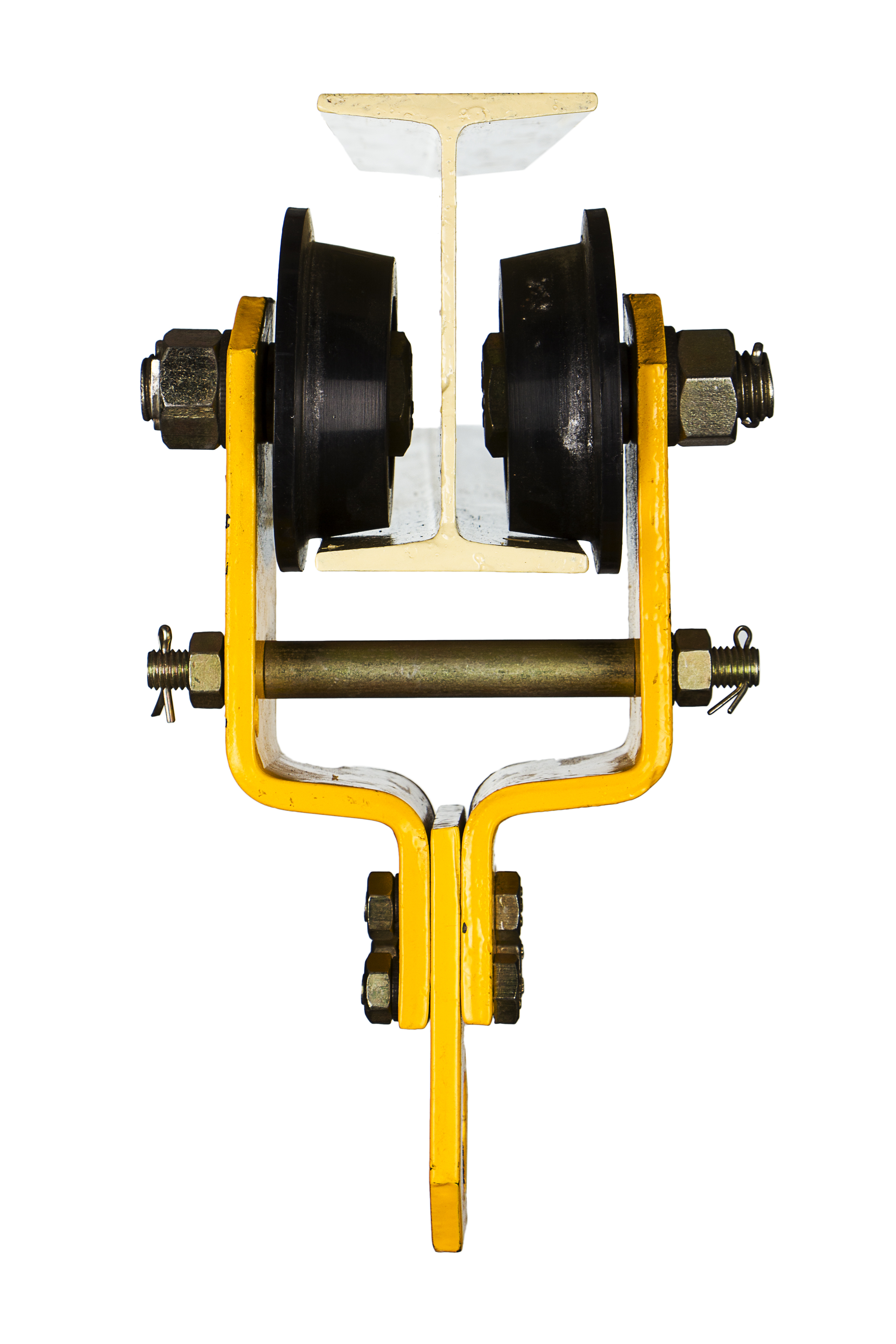 | PUSH-PULL TROLLEYS 1/4 TON (2 WHEEL) PUSH-PULL TROLLEYS The 1/4 Ton (2 Wheel) Push-Pull Trolley by Hendo Industries is a compact and reliable solution for smooth material handling in industrial... View product → |
 | PUSH-PULL TROLLEYS 1/2 TON (4 WHEEL) PUSH-PULL TROLLEYS The 1/2 Ton (4 Wheel) Push-Pull Trolley by Hendo Industries is specially designed to provide smooth and efficient material handling for various... View product → |
Frequently asked questions
How do you calculate push pull trolley capacity for a factory load?
Add the payload to the trolley, hoist, tool, hook, slings, shackles, and every other suspended component. Compare that total with the trolley’s marked working load limit, or WLL.
When is a quarter-ton push pull trolley suitable?
A quarter-ton push pull trolley suits a complete suspended load up to 250 kg only when the beam, travel conditions, and other handling components also support that rating.
What is the difference between half-ton, one-ton, and two-ton options?
A half-ton push pull trolley is rated up to 500 kg, a one-ton push pull trolley up to 1,000 kg, and a two-ton option up to 2,000 kg. Use the rating for the complete suspended load and retain a real operating margin.
What should you verify before ordering a push pull trolley?
Confirm the beam flange width and profile, beam capacity, trolley WLL, wheel compatibility, travel path, load frequency, floor conditions, and the ratings of the hoist, hook, slings, and connections.
Related products
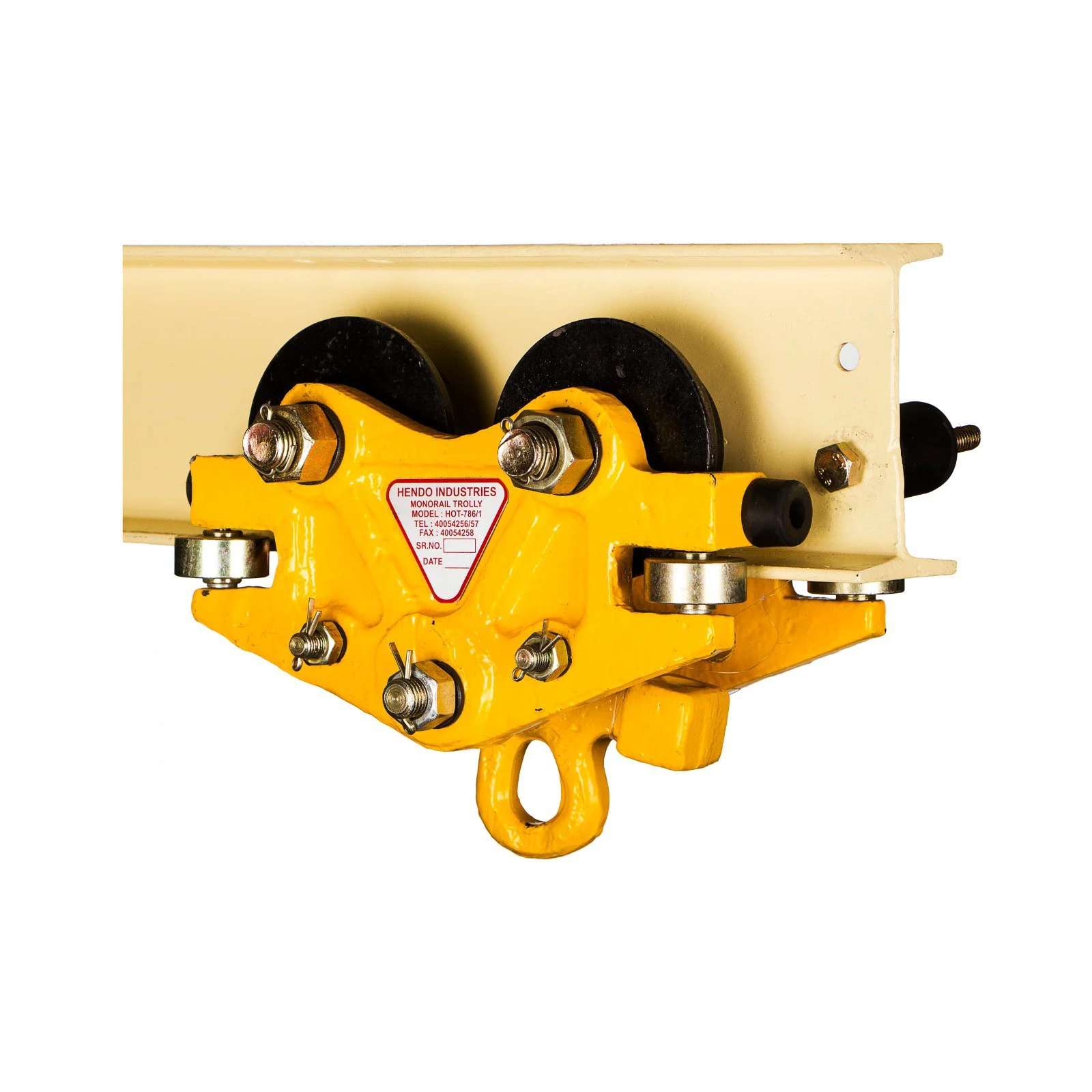 | PUSH-PULL TROLLEYS 1 TON (4 WHEEL) PUSH-PULL TROLLEYS The 1 Ton (4 Wheel) Push-Pull Trolley by Hendo Industries is a durable and efficient material handling solution designed for smooth movement of heavy... View product → |
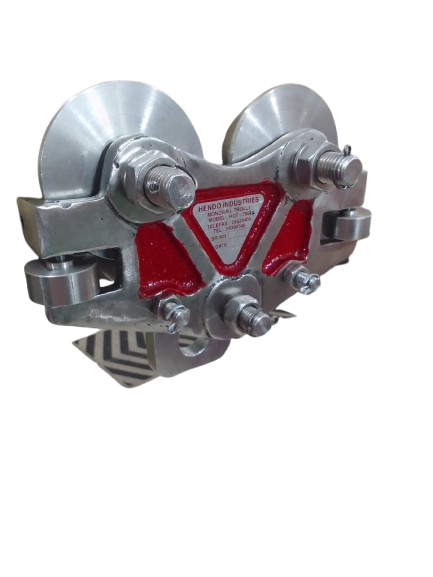 | PUSH-PULL TROLLEYS 2 TON (4 WHEEL)- Stainless Steel PUSH-PULL TROLLEYS The 2 Ton (4 Wheel) Stainless Steel Push-Pull Trolley by Hendo Industries is engineered for smooth and reliable material handling in demanding... View product → |