The correct balancer depends on the complete suspended mass, required cable travel, mounting structure, tool reaction forces, and Chennai’s heat, humidity, dust, and washdown exposure. By the end, you will be able to compare HLSB-22 and HLSB-30 from verified datasheet values, reject unsuitable installations, and run a station trial before approval.
Key takeaways
- Weigh every suspended component together before selecting a balancer.
- Compare HLSB-22 and HLSB-30 with the station’s actual reach and movement.
- Choose another support when tool torque, travel or mass exceeds spring-balancer limits.
- Approve production only after a loaded trial at the Chennai station.
Choose by complete suspended mass, not the tool catalogue weight
A calibrated scale must measure the tool exactly as it will hang, not the tool’s catalogue mass. Include the tool, chuck or die, socket, hose, cable, quick coupler, safety lanyard, reaction arm, balancer hook, and fixture.
- Hang every component from the same lifting point used at the station.
- Record the complete suspended mass at the intended cable extension.
- Add accessories that operators install during production, not only those supplied with the tool.
That static mass is not peak pull force, start-up shock, hose drag, torque reaction, or side load. A spring balancer supports vertical weight; it does not control a nutrunner’s reaction torque, a riveter’s thrust, grinder lateral force, or a long horizontal pull.
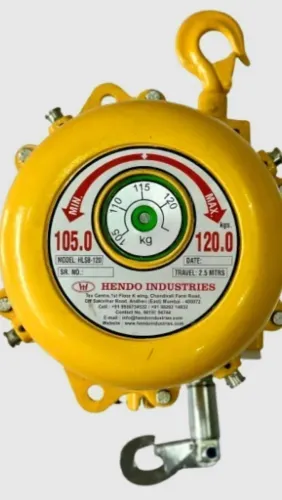
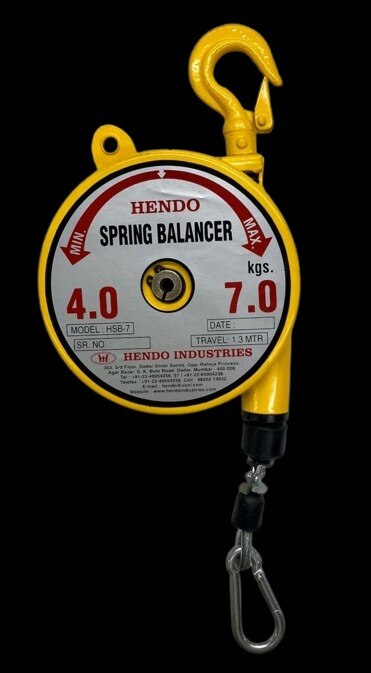
HLSB-22 and HLSB-30 are model names, not proof of capacity. Request the manufacturer’s safe working-load range, minimum load, adjustment range, usable stroke, duty rating, and serialised nameplate data before choosing either model.
| Required data | HLSB-22 | HLSB-30 |
|---|---|---|
| Safe working-load and minimum-load range | Manufacturer datasheet | Manufacturer datasheet |
| Adjustment range and usable stroke | Manufacturer datasheet | Manufacturer datasheet |
| Duty rating and serialised nameplate | Verified before purchase | Verified before purchase |
Choose the model whose operating range places the complete suspended mass away from both adjustment limits, rather than automatically choosing the larger model. Oversizing can pull a light tool upward and reduce positioning control in a sheet metal tool support automotive plant.
Apply this rule when selecting a sheet metal spring balancer for automotive plants in Chennai.
Compare HLSB-22 and HLSB-30 against the station’s real reach
A nominal 2.5 m cable is not automatically a 2.5 m working reach. Measure mounting height, the operator’s hand position, vehicle roof line, underbody station, side-panel fixture, and the cable’s vertical path before choosing between an hlsb 22 spring balancer in chennai and an hlsb 30 spring balancer in chennai.
Use this buyer’s comparison framework, and replace every blank with the current manufacturer datasheet value and serialised nameplate data:
| Item | HLSB-22 | HLSB-30 |
|---|---|---|
| Rated load | Current datasheet: _ | Current datasheet: _ |
| Minimum load | Current datasheet: _ | Current datasheet: _ |
| Usable stroke | _ m | _ m |
| Cable or wire-rope diameter and construction | _ | _ |
| Body dimensions | _ | _ |
| Mounting method | _ | _ |
| Adjustment range | _ | _ |
| Duty or cycle rating | _ | _ |
| Operating temperature | _ | _ |
| Corrosion provisions | _ | _ |
| Net weight | _ kg | _ kg |
Do not infer these values from the model names. Confirm cable exit angle, trolley or overhead-rail travel, clearance at full extension, and clearance around the vehicle. Pulling sideways creates cable rubbing, extra force, poor return, and premature failure; insufficient stroke makes the operator drag the tool instead of retrieving it.
- Record reach at the roof, underbody, and side-panel positions.
- Check hose drag, fixture collision, and full-extension clearance.
- Select the model that balances the actual suspended load within its adjustment range, not automatically the larger unit.
Match the balancer to the tool and know when another support is better
Select a spring balancer for sheet metal tools by verified suspended mass, balance behaviour, duty cycle, torque reaction, and required orientation—not by tool name. A light screwdriver, drill, riveter, grinder, nutrunner, weld gun, or clinching tool still needs a load-range check with its chuck, hose, socket, die, and accessories attached.
A spring balancer supports vertical weight; it does not control nutrunner reaction torque, riveter thrust, grinder lateral force, or a long horizontal pull. Add a torque arm, reaction bar, articulated support, or separate restraint where the station generates those forces.
| Support | Prefer it when | Limitation |
|---|---|---|
| Fixed tool hanger | The tool stays at one location and needs simple storage | No assisted retrieval or travel |
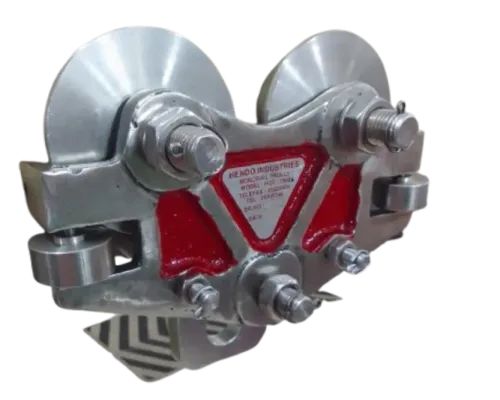
| Overhead trolley | The operator needs horizontal movement along a rail | Does not balance reaction forces |
| Pneumatic balancer | Powered positioning and frequent height changes matter | Needs air supply, controls, and maintenance |
| Electric hoist | Loads fall outside the verified spring range or require precision vertical lifting | Slower, powered lifting system |
| HLSB-70, HLSB-105, HLSB-120, or HLSB-150 | Long stroke is required after measuring the full work envelope | Larger units can increase pull and clearance demands |
| Spring balancer | Vertical retrieval suits the tool’s complete mass and duty cycle | Unsuitable for sustained horizontal pulling |
Confirm the selected model’s safe working range and neutral return behaviour on the actual station. Oversizing can make a light tool rise unexpectedly; undersizing causes drift, bottoming, and unsafe side-loading.
Install and maintain the unit as part of the station safety system
A balancer is only as safe as the structure carrying it. Complete this installation checklist before loading the tool:
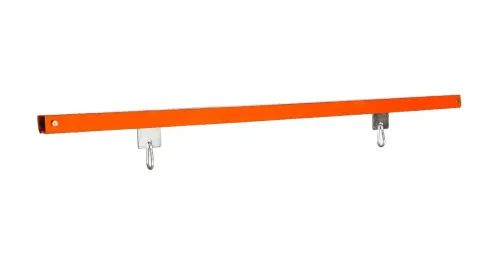
1. Verify the beam, bracket, drop rod, trolley, or rail for the balancer’s static load plus foreseeable dynamic and side loads. Inspect anchor points, use an independent secondary retention, confirm the hook latch, and protect the cable from sharp edges and rubbing. Check clearance from conveyors, fixtures, robots, vehicle bodies, sheet-metal panels, and operator walkways.
Never fix it to light-gauge roof sheet, an unverified cable tray, or an underspecified support.
2. Set the spring for the complete suspended mass and lock the adjustment after commissioning. Never exceed the rated load, pull the cable sideways, release a tool uncontrolled, or increase spring tension to compensate for a heavier replacement tool. Isolate and secure the unit before maintenance.
3. Record the inspection interval, with shorter intervals for heavy duty, salt air, or washdown. Check for frayed or kinked cable, outlet rubbing, damaged hooks, casing deformation, spring noise, uncontrolled recoil, lost return force, loose bolts, and damaged stop hardware. Remove the balancer from service after overload, impact, or failed return.
4. Specify corrosion protection for Chennai heat, humidity, dust, oil mist, and salt air. Use protected housings, compatible corrosion-resistant fasteners, drainage without water traps, and shielding from alkaline cleaners, phosphating chemicals, weld spatter, and direct washdown. A normal load rating does not protect against chemical attack. Document every finding and corrective action.
Approve the Chennai installation only after a loaded station trial
Do not approve the balancer from a catalogue demonstration. Release the Chennai station only after the supplier documents these purchasing facts:
1. Record complete tool weight at the hook, including hose, socket, die, reaction arm, lanyard, quick coupler, cable, accessories, and fixture. Specify required reach, line speed, duty cycle, mounting structure, heat, humidity, oil mist, dust, cleaners, and washdown exposure.
2. Require the current datasheet, serialised nameplate, mounting guidance, safe working-load range, adjustment limits, usable stroke, cable specification, replacement-spring and cable procedures, spare-part availability and lead times, service response, delivery date, and commissioning support.
3. Hang the actual tool with its hose, socket, die, reaction arm, lanyard, and accessories at the station. Have operators test one-hand retrieval and observe neutral tool position, shoulder elevation, return speed, drift after release, cable angle, hose drag, cable rubbing, collision points, vehicle-panel clearance, and stability at full extension and retraction.
4. Reject the trial if the unit is oversized, lacks stroke, or side-loads the cable. An operator’s movements expose those faults; a no-load demonstration does not.
Ask a Chennai manufacturer or supplier, including Hendo Industries, to verify each result before choosing HLSB-22 or HLSB-30. Lock the spring adjustment after commissioning so nobody compensates for a heavier replacement tool by increasing upward force.
Related products
 | SHEET METAL SPRING BALANCER HLSB-22 (2.5 MTRS) SHEET METAL SPRING BALANCER The HLSB-22 (2.5 MTRS) Sheet Metal Spring Balancer by Hendo Industries is a durable and high-performance industrial balancing solution designed for... View product → |
 | SHEET METAL SPRING BALANCER HLSB-30 (2.5 MTRS) SHEET METAL SPRING BALANCER The HLSB-30 (2.5 MTRS) Sheet Metal Spring Balancer by Hendo Industries is a robust and efficient industrial tool balancing solution designed to... View product → |
Frequently asked questions
What weight should you use when selecting a sheet metal spring balancer?
Measure the complete suspended mass: tool, chuck or die, socket, hose, cable, quick coupler, safety lanyard, reaction arm, balancer hook and fixture.
How should you compare an HLSB-22 spring balancer with an HLSB-30 spring balancer in Chennai?
Compare each model’s rated capacity and cable travel with the station’s measured suspended mass, required reach and working height. Use the manufacturer’s nameplate and technical data rather than the tool catalogue weight.
When is a spring balancer the wrong support for a sheet metal tool?
Use another support when the station requires more capacity or travel than the balancer provides, or when tool torque, reaction force or positioning accuracy exceeds what a suspended spring unit can control.
How do you approve a balancer installation for an automotive plant?
Run the fully loaded station through its real operating cycle, checking reach, return movement, cable routing, tool position, operator posture, anchor security and interference before production approval.