A suspended fastening tool feels nearly weightless because a flat steel spring applies torque to a cable drum that counteracts the tool’s torque. By tracing that mechanism, the operator’s movement, the mounting geometry, and the complete suspended load, you can decide whether a balancer will fit a station safely and how to specify one without guessing from a model number.
Key takeaways
- Match the balancer’s rated load to the complete suspended tool assembly.
- Set travel for the full working zone, not just the operator’s reach.
- Mount above the workstation with a load-rated support and clear cable path.
- Compare HLSB-22 and HLSB-30 using their capacity and travel specifications.
Inside the balancer: how spring torque offsets tool weight
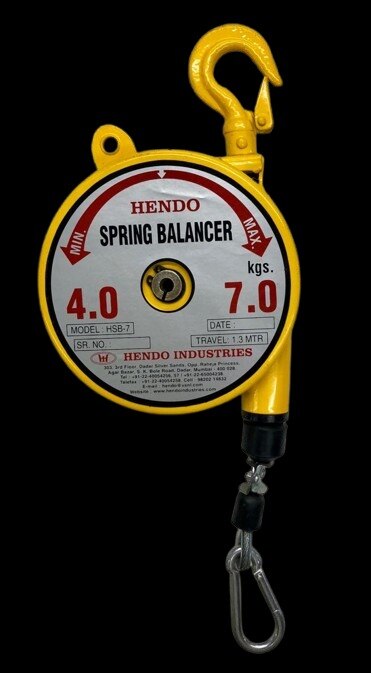
A flat, coiled steel spring inside the housing stores torque as the cable winds onto its drum. The cable runs over the drum to a hook carrying the tool, while the tool’s weight creates opposing torque.
Adjust spring tension until those forces nearly cancel, allowing the tool to stay at the operator’s chosen height instead of dropping or requiring continuous lifting.
To see how sheet metal spring balancers work, consider the adjustment result:
- Within the rated range, spring torque offsets the complete suspended assembly and produces near-neutral support across the working travel.
- Below the adjustment range, spring force pulls the tool upward, so it retracts or feels difficult to lower.
- Above the adjustment range, tool weight wins, leaving downward force and reducing control.
The rated mass includes the tool, chuck or socket, adapters, reaction arm, carried hose or cable, and accessories. Using bare tool weight can consume the adjustment range before the station is commissioned.
A simple drum does not deliver perfectly constant force: cable force is approximately spring torque divided by effective drum radius, and each added cable layer changes that radius. Constant-force spring geometry, a tapered or shaped drum, or compensation mechanisms reduce this variation.
A balancer supports positioning, not people, and it is not automatically a lifting device. Do not leave a tool hanging unattended unless the model and installation permit it; use positive parking or retention for the parked tool.
What happens during a fastening cycle
A downward pull unwinds the cable from the drum and lowers the tool to the fastening point. The flat steel spring tightens as it stores energy, while its torque offsets the tool’s weight so the operator guides rather than lifts the suspended assembly.
- Pull the tool down in line with the balancer. A straight cable path keeps the hook, cable, and drum loaded axially; a sideways pull causes cable rubbing, hook loading, and drum-flange wear.
- Position the tool over the fastener, then move it across the work area without forcing the cable over an edge. If the tool creeps upward, the spring setting is too strong; if it sinks, the setting is too weak for the complete suspended load.
- Release the trigger or handle after fastening. The spring retracts the cable and raises the tool toward its rest position, but the return force is not perfectly constant because cable layers change the drum radius.
- Park the tool on a defined hook, cradle, balancer lock, or other positive retention point. Do not leave it hanging unattended unless the specific balancer and installation are rated for that condition.
Sheet metal spring balancer operation depends on the entire suspended assembly, including the tool, socket, hose, cable, and fittings. A damaged or bird-caged cable, abnormal stacking, or upward or downward creep calls for inspection and repair—not increased spring tension.
Mounting the balancer above an automotive workstation
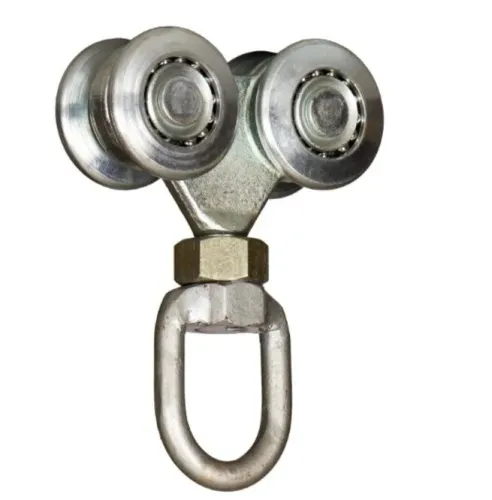
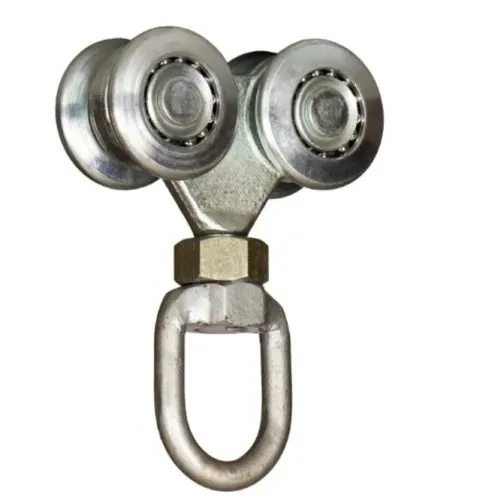
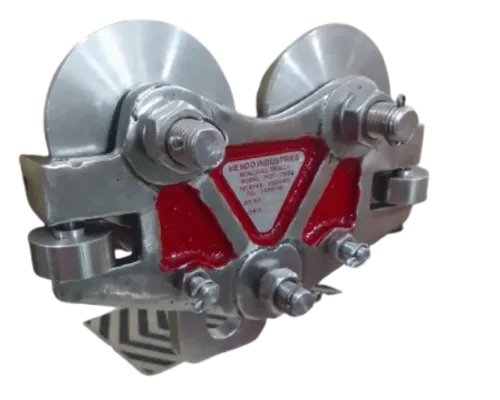
Mount the balancer to a load-rated overhead beam, trolley, or bracket that can carry the complete suspended assembly and operating forces. Use the manufacturer’s specified fastener size, quantity, spacing, and locking method; do not attach it to thin sheet metal, an unverified guard, or a cable tray.
Inspect the anchor for cracks, corrosion, deformation, and loose hardware before installation.
Position the housing so the cable runs vertically through the working zone without rubbing the casing, drum, beam, trolley, or nearby steelwork. Leave room for:
- The housing to move without striking the vehicle, fixture, or overhead equipment.
- The hook and tool to reach every required fastening point without side-loading the cable.
- The operator to stand clear of the cable’s return path and the tool’s swing.
- Hoses and electrical leads to follow a controlled route without snagging or pulling the balancer sideways.
Fit the secondary safety chain or retaining device to an independent structural point. It must arrest a failed housing or primary suspension without carrying the normal load or restricting travel. A safety chain does not make an inadequate beam or fastener arrangement acceptable.
After fitting the tool, pull it through its full working stroke and check that it remains aligned at the lowest and highest positions. Stop the installation if the cable stacks unevenly, the tool creeps, the hook latch is damaged, or the spring requires adjustment beyond its stated load range.
Do not leave the tool suspended unattended unless the model and installation permit it; provide positive parking retention.
Sizing travel and load for a 2.5 metre spring balancer
Measure the fastening envelope from the balancer’s mounting point, not from the vehicle. A 2 point 5 metre spring balancer normally provides up to 2.5 metres of cable travel; it does not describe ceiling height, housing length, or the operator’s usable reach.
Mark the nearest and farthest fastening points, then include the hook, tool length, and clearance needed to approach each point without pulling the cable sideways.
- Confirm that the cable’s required vertical travel stays within 2.5 metres, including the lowest and highest working positions.
- Add the complete suspended mass: tool, chuck or socket, adapters, reaction arm, carried hose or cable, and accessories.
- Compare that total with the model’s published load range and adjustment range, not merely its maximum rating.
- Check the tool at every marked position; binding, excessive pull force, or cable slack indicates a poor match.
- Provide a positive parking or retention arrangement if the tool will remain suspended unattended.
A tool that exceeds the load range will not balance neutrally and can descend unexpectedly; a tool below the range can retract too aggressively. Long travel also increases cable flexing and side-loading risk, so support hoses separately and keep the cable aligned with the tool path.
Do not treat the balancer as a lifting or personnel-support device, and verify the installation’s secondary safety provision before production use.
Comparing HLSB-22 and HLSB-30 without guessing capacity
The numbers 22 and 30 are catalogue identifiers, not universal ratings. Treat “hlsb 22 spring balancer” and “hlsb 30 spring balancer” as two candidates, then verify the published specifications for the exact series and revision.
| Check | HLSB-22 | HLSB-30 |
|---|---|---|
| Published load range | Record the minimum and maximum supported assembly weight | Record the minimum and maximum supported assembly weight |
| Cable travel | Confirm the stated stroke, not the model number | Confirm the stated stroke, not the model number |
| Cable diameter and construction | Match the cable to the tool, hose, and duty cycle | Match the cable to the tool, hose, and duty cycle |
| Mounting orientation | Use only the orientations listed by the manufacturer | Use only the orientations listed by the manufacturer |
| Locking feature | Confirm whether a lock is fitted and how it engages | Confirm whether a lock is fitted and how it engages |
| Safety provisions | Check secondary retention and any specified safety device | Check secondary retention and any specified safety device |
Weigh the complete suspended assembly: tool, socket or bit, hose, fittings, and any adapter. Select the model whose stated range contains that total, with no adjuster forced past its stop; extra preload cannot make an undersized cable, drum, housing, or mount safe.
For Hendo Industries equipment, request the model datasheet and installation instructions before comparing quotations. Confirm the beam, trolley, or bracket accepts the specified fasteners and load, then align the housing so the cable leaves the drum without rubbing. Add positive tool parking or retention if the tool will be left unattended.
Related products
 | SHEET METAL SPRING BALANCER HLSB-22 (2.5 MTRS) SHEET METAL SPRING BALANCER The HLSB-22 (2.5 MTRS) Sheet Metal Spring Balancer by Hendo Industries is a durable and high-performance industrial balancing solution designed for... View product → |
 | SHEET METAL SPRING BALANCER HLSB-30 (2.5 MTRS) SHEET METAL SPRING BALANCER The HLSB-30 (2.5 MTRS) Sheet Metal Spring Balancer by Hendo Industries is a robust and efficient industrial tool balancing solution designed to... View product → |
Frequently asked questions
How does a sheet metal spring balancer offset tool weight?
A flat coiled steel spring stores torque as the cable winds onto the drum. That spring torque counteracts the opposing torque created by the suspended tool’s weight.
What happens during an automotive fastening cycle?
The operator pulls the tool down and across the work area, then releases or repositions it as the spring retracts the cable toward its balanced position.
How should you mount a spring balancer above an automotive workstation?
Fix it to a load-rated overhead support, align the cable with the tool’s working path, and keep the cable clear of sharp edges and moving equipment.
How do you size a 2.5 metre spring balancer?
Confirm that the 2.5 metre travel reaches every fastening point, then match the balancer’s rated load to the tool, hose, fittings, and accessories suspended from the cable.
How do you compare an HLSB-22 spring balancer with an HLSB-30 spring balancer?
Compare their published load range, cable travel, mounting arrangement, and adjustment features. Do not infer capacity from the model number alone.