A two-ton rating alone does not tell you whether a trolley will fit your facility, move safely, or survive its cleaning process. Before you request a quote, define the load, floor conditions, dimensions, stainless grade, wheel arrangement, delivery scope, and dispatch date so you can compare suppliers on facts rather than on the phrase “heavy duty.”
Key takeaways
- State the 2,000 kg working load and movement method before requesting quotes.
- Measure doorways, turning areas, ramps, thresholds and deck loading points.
- Choose stainless grade, weld finish and wheels for the workplace contamination and floor.
- Confirm stock, lead time, delivery terms and a reachable New Delhi contact.
Start with the load rating and intended method of movement
Specify a 2,000 kg rated working load and the intended method of movement before asking a stainless steel push pull trolley supplier for a quotation. State whether one operator will push, pull, or use a powered aid, and identify ramps, floor joints, thresholds, gradients, and contamination on the route.
1. Ask the supplier to state whether the 2-ton rating means 2,000 kg uniformly distributed, concentrated, or both, and provide each wheel’s capacity.
2. Request starting-force and rolling-force figures for the loaded trolley. If those figures are unavailable, require a demonstration on your actual floor with the proposed wheels and load.
3. Require a general-arrangement drawing showing deck length and width, deck and handle height, overall footprint, wheel locations, overall height, and turning envelope.
4. Specify the stainless grade, such as 304 for general indoor service or 316 for chloride exposure, saline wash-down, or aggressive chemicals. Put weld finish, surface finish, wheel material, wheel diameter, and brake type on the enquiry.
5. Ask for the delivery condition, net trolley weight, warranty exclusions, test or inspection record, and any assembly or commissioning requirement.
A nominal 2-ton stainless steel trolley proves only that its frame carried a stated load in a particular test. It does not prove that one person can start, steer, or stop it safely across your route. Get the force data or arrange the loaded trial before comparing prices.
Check the trolley’s dimensions, turning space, and deck loading
A 2 ton stainless steel trolley will fit only if its loaded envelope matches your narrowest route, not merely if its frame is rated for 2,000 kg. Measure the clear width and height of every door, lift entrance, aisle, ramp, and loading-bay approach, then compare them with the trolley’s overall dimensions and turning envelope.
| Measurement | What to confirm | Why it matters |
|---|---|---|
| Deck length and width | Usable platform area and load footprint | A load that overhangs can strike doors, racks, or people |
| Overall length and width | Frame, handles, wheels, and guards included | Determines passage through doors and lift cars |
| Deck height and handle height | Unloaded and loaded dimensions | A high deck can obstruct loading; a high handle can hit shutters |
| Wheel diameter and locations | Wheel size, axle spacing, and swivel-wheel position | Affects ramp clearance, stability, and turning space |
| Turning envelope | Minimum swept circle with the stated load | A trolley can fit an aisle yet fail at a 90-degree turn |
| Net weight | Trolley weight without the payload | Sets lift, ramp, floor, and unloading requirements |
Request a general-arrangement drawing showing each dimension, wheel location, overall height, and turning envelope. Ask the supplier to mark the maximum distributed-load footprint that achieves the 2,000 kg rating, and state whether the rating covers a uniformly distributed load, a concentrated load, or both.
A quoted “two ton” capacity without that loading condition is not enough.
Match stainless grade, weld finish, and wheels to the workplace
Choose 304 stainless steel for ordinary indoor handling, but specify 316 where chloride exposure, saline wash-down, or aggressive cleaning chemicals are expected. Ask a stainless steel push pull trolley supplier to state the grade on the quotation and provide a material certificate; “SS” is not a sufficient specification.
| Feature | Compare | Workplace consequence |
|---|---|---|
| Stainless grade | 304 or 316 | 304 suits dry indoor service; 316 gives better resistance to chlorides and harsh cleaning |
| Weld finish | Smooth, crevice-free welds with passivation; pickling where appropriate | Heat tint, rough welds, and embedded carbon-steel particles can start corrosion and trap contamination |
| Wheel tread | Polyurethane, nylon, or rubber matched to the floor | Polyurethane reduces marking and noise; nylon rolls efficiently on smooth floors but can be harsh on joints; rubber copes better with uneven surfaces |
| Wheel arrangement | Swivel and fixed castors with rated brakes | The layout controls turning effort, tracking, and whether the parked load stays secure |
Inspect welds rather than judging the trolley by sheet grade alone. A cleanable finish matters in wash-down areas, where residue inside a crevice can corrode even 316 stainless steel.
Check each wheel’s capacity, not only the two-ton total. Require loaded starting and rolling-force information, then test the trolley on your actual floor, including joints, ramps, thresholds, and any contamination. Confirm brake operation, wheel diameter, and replacement-wheel availability before accepting the offer.
Decide whether a push-pull trolley is safer than the alternatives
A 2,000 kg rating does not prove that one person can move a loaded push-pull trolley safely. Choose manual movement only after the supplier provides starting and rolling-force figures or demonstrates the full load on your actual floor, including thresholds, ramps, joints, and contamination.
| Option | Choose it when | Main safety limit |
|---|---|---|
| Manual push-pull trolley | The route is short, level, clean, and the demonstrated force suits the operator | Do not rely on the load rating to prove one-person handling |
| Pallet truck | The load sits on a standard pallet and you need short-distance floor movement | It is unsuitable for loose loads, narrow turning areas, or long travel |
| Powered tug | The trolley travels far, crosses gradients, or needs repeated movement | Specify towing eyes, operator position, speed control, and braking |
| Forklift | You need to lift, stack, load vehicles, or move across uneven yards | Confirm fork pockets, load centre, visibility, and exclusion zones |
| Overhead trolley | The route is fixed and the load must stay off the floor | It requires engineered beams, end stops, rated hoists, and fall protection |
When comparing an industrial trolley in New Delhi, state the travel distance, floor gradient, operator position, and moving method in your enquiry. Select a manual unit only for controlled floor travel; choose powered equipment when force, distance, traffic, or gradient exceeds that control. For forklift handling, request a drawing confirming pocket size and load balance.
Confirm stock, lead time, delivery, and the supplier’s New Delhi contact route
A supplier listing does not prove that a unit is sitting in New Delhi. To buy a two-ton stainless-steel push-pull trolley in New Delhi, ask whether the model is off the shelf or made to order, then request a written stock position, firm dispatch date, drawing-approval deadline, and pre-dispatch dimensional inspection point.
Send the enquiry through the supplier’s published New Delhi phone number, email, or WhatsApp route and request these details in the quotation:
- Stock status, manufacturing lead time, dispatch location, and the earliest delivery date.
- General-arrangement drawing showing deck size, overall footprint, handle height, wheel locations, turning envelope, and overall height.
- Stainless grade, wheel-by-wheel capacity, brake type, net weight, and the distributed-load footprint used for the 2-ton rating.
- Delivery condition: assembled or knocked down, with freight, unloading, assembly, commissioning, and site-access requirements stated separately.
- Price basis: GST, transport, unloading equipment, installation, test or inspection record, warranty, and warranty exclusions.
Ask whether local delivery covers your gate only or includes unloading at the loading bay. A fabricated trolley might require a truck, ramp, crane, or forklift rather than parcel service.
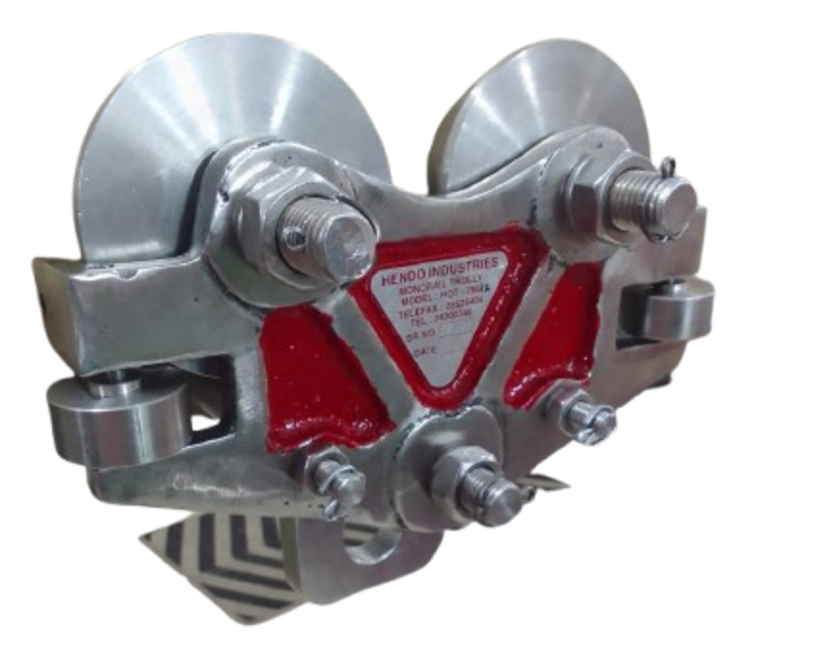
Hendo Industries can be included in your comparison for an industrial trolley in New Delhi, but verify its current stock, dispatch point, and written inclusions instead of treating the product listing as proof of immediate availability.
Related product
 | PUSH-PULL TROLLEYS 2 TON (4 WHEEL)- Stainless Steel PUSH-PULL TROLLEYS The 2 Ton (4 Wheel) Stainless Steel Push-Pull Trolley by Hendo Industries is engineered for smooth and reliable material handling in demanding... View product → |
Frequently asked questions
What load rating should you request for a two ton stainless steel trolley?
Request a 2,000 kg rated working load and explain how the trolley will move. State whether one operator will push, pull, or use a powered aid.
Which dimensions should you check before buying an industrial trolley in New Delhi?
Check deck length and width, overall height, handle clearance, doorway width, turning space, ramp gradients, floor joints, thresholds and the position of the load on the deck.
Which stainless steel and wheel details matter for a push-pull trolley?
Match the stainless grade and weld finish to moisture, chemicals and cleaning methods. Choose wheels for the floor surface, load, thresholds, gradients and required rolling resistance.
When is a push-pull trolley safer than other material-handling options?
A push-pull trolley suits loads that need controlled manual movement over a defined route. Use a powered aid when the load, gradient, distance, floor condition or starting force exceeds safe manual handling limits.
What should you confirm with a stainless steel push-pull trolley supplier before ordering?
Confirm the quoted working load, dimensions, configuration, stainless grade, wheel specification, stock status, lead time, delivery arrangements and the supplier’s New Delhi contact route.